When time travel arrives, and you can choose to go backwards or forwards in time, which one will you take–yesterday or tomorrow? While the question is hypothetical, still it is something you may want to consider. Really, give it some thought as you do your workout on the treadmill or as you fight the commute home. I figure the answer you give will tell you a lot about yourself, much like a gender reveal party for an unborn baby.
The question came to me as a result of watching–almost back to back–two TV shows, one about a woman who finds herself centuries in the past, the other about a woman who finds herself decades in the future. (In the service of full disclosure, I watched a few minutes at the start of the former and I watched a few minutes at the end of the latter.)
I found it amusing that these two shows operated on the same premise—someone being transported in time—but in linear opposites, past and future. Of course, both women faced similar problems upon arrival, such as shock, setbacks, and stupefied hosts. Another problem, quickly addressed, was finding a new wardrobe so they would blend in without too much ruckus.
The woman who found herself in the past chose to keep her situation a secret, which made good sense, because she was in the middle of a political revolt in which she was suspected of being a possible spy. The woman who leapfrogged into the future tried the opposite—to convince everyone that she was from the past. She ended up with pity–for the most part–because of her departure from reality.
Of course, the idea of finding yourself in a time warp has been a favorite theme of multiple television shows (Back to the Future, Doctor Who, Quantum Leap). But, as we know, before there was television there was literature. The argument could be made that all these time travel TV shows are just variations on the theme of “Rip Van Wrinkle,” a story written by Washington Irving in 1819. Likewise, there are other literary giants who played with the same idea, like Mark Twain did in “A Connecticut Yankee in King Arthur’s Court” in 1889, or H.G. Wells did in “The Time Machine” in 1895.
So, the parlor game of thinking about time travel is an old one, which in itself raises the question of why we are so interested in visiting the past or in visiting the future. For my part, I think it may have something to do with our search for answers, such as “What was George Washington like in person?” Or, “I wonder what it was like to watch the pyramids being built?” Or, “Wouldn’t it have been exciting to be there when Paul Revere rode his horse through Concord on that dark night of 1775?” We have many questions that we want to ask the past.
We also have questions that we want to ask the future. “How will we move around in a hundred years?” Or, “Will artificial intelligence be smarter than humans in the future?” Or, “Will learning be done by injections into the brain?” While it is more difficult to imagine the future, it is not impossible for creative minds. Remember, it was far-sighted Leonardo da Vinci who envisioned the possibility of airplanes in the 15th century when he looked at the flight of birds.
For some years, I’ve imagined going back to the past. That is the direction that my curiosity takes me. Not the ancient past. I’m more interested in meeting up with old relatives on the family tree four or five generations ago. I would like to see for myself the real person, not just a name on a wrinkled page in some family album. I’d like to see these family members in their habitat, much like watching a video feed of deer in the forest.
The next best thing, I suppose, is dressing up and acting the part of old timers, like those guys who every year gather to re-enact Civil War battles. They aim for authenticity, as much as it is possible. We often read or hear about other people who have similar historical interests and who play much the same dress-up dramas to take them back to the past, at least for a weekend.
A few years ago, a guy named Rinker Buck was so fascinated with people who traveled the Oregon Trail that he convinced his brother Nick to join him on a summer trip from Missouri to Oregon. The two of them, with Buck’s dog, Olive Oyl, made their way in a covered wagon with some mules across 2000 miles of ruts and ravines and roads retracing the travels of those pioneers. He allowed himself a few modern conveniences, but nonetheless tried to live the authentic outdoors experience . He wrote a book about it. It is well worth reading.
Still, his approach of experiencing the past was a lot of hard work. I’m more interested in the weekend visitor approach or the Easter Sunday churchgoer experience which would provide me with a taste of the times, but wouldn’t require any blood, toil, tears, or sweat, to quote Churchill, who also lived in hard times. What Buck and his brother learned was that traveling the Oregon Trail was no Saturday night camp out in the woods and no Sunday afternoon picnic in the park. He’d be the first to admit it was brutal. Imagine, then, what the real thing must have been like.
And that’s the problem with time travel. Could we really make it if we suddenly were lifted out of our La-Z-boy recliner and landed on the seat of a covered wagon staring at the rear ends of two mules? And, for the sake of argument, say we got the mules under control, would we know how to make a campfire, or how to hunt down Peter Rabbit for supper, or how to survive a snow storm in a sod house on the South Dakota state line? I don’t think I could, even if necessity is said to be the mother of invention.
Without a doubt, I’d be just as ill-equipped to handle the future. Sometimes an escalator is a challenge, much less a transporter in the Star Trek style in which I would have to step into a tubular apparatus and be converted into an energy field and trust all my molecules would stay together while I’m beamed to my new location. And sometimes figuring out the microwave is a massive problem for me because it has too many controls. Who knows how food will be cooked in the next century? Maybe I wouldn’t have to prepare meals, just know how to operate a juicer.
Yet, if scientists are right—or even half-right—the future may require more stamina and strength than the past did, with coastal cities underwater, and forest fires rampant, and heat waves a way of life, and no clean air to breathe, to name just a few scary predictions that scientists foresee for the future. The latest news says there won’t be any oysters left to eat.
Not to mention scarcity of water, continuous crop failures, massive relocation of populations. These scenarios make crossing the Oregon Trail look like indoor climbing. I have a friend who likes to say we should be grateful that we can’t see the future. He’s probably right. If we saw it, I fear we’d freeze from fright like a squirrel on a busy highway.
But in either case—a blast into the past or a departure to the future—these problems are physical concerns. The nitty-gritty—as I see it—has to do with something deeper than having no indoor plumbing and no way to fight off a grasshopper infestation. And that “deeper something” has to do with the question of whether or not we would feel at home in the past or in the future upon our arrival there.
Would we find our place in either setting? Would we want to stay? Would we get our answers? Those are soul questions, not body questions. Or would we feel like Lt. Nolan in Edward Everett Hale’s story, “The Man Without A Country”, who dreams of a return to the shores of his homeland, but is condemned to float on the high seas for the rest of his life?
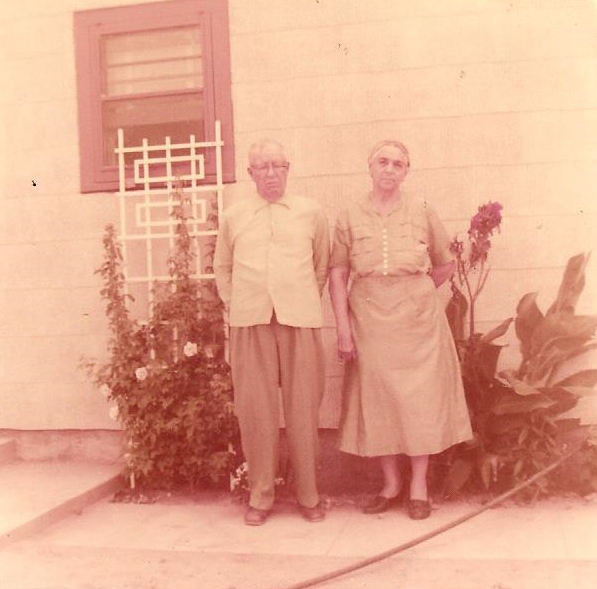
As my grandmother grew older, she grew more uncomfortable with the world in which she found herself. As a young girl, she grew up on the open prairies of Nebraska, where she lived through blizzards that killed man and beast alike, where the merciless winds drove women and children crazy, and where the next meal depended on a stray prairie chicken or the wheat crop that was wiped out by those gluttonous grasshoppers. You’d think she might like the more settled and secure world that she found towards the end of her life. But she didn’t.
As she saw it, the world had lost its familiarity. Little felt the same to her. Values she held dear had changed into values with which she didn’t agree. As she listened to the Huntley-Brinkley Report each evening in the early 1960s, she found herself not feeling at home anymore. She didn’t trust the future.
That fact was showed when she and my grandpa moved in 1954 from their farmhouse into town, where they built for themselves a small new home. During construction, my grandmother insisted that the builder put an outhouse in the garage that was detached from the house. She didn’t trust indoor plumbing. I should point out that her skepticism proved correct on several occasions when electricity failed and the electric water pump in the well couldn’t fill up the indoor commode.
I remembered it when I recently read something similar about the writer, Laura Ingalls Wilder. Wilder was the author of the eight volume “Little House on the Prairie” children’s series that told about her life as a young girl in the mid and late 1800’s growing up on the plains of Iowa and South Dakota. Many years later–according to a biographer–Laura’s daughter, Rose, had a new house built for her mom and dad, who now lived in Missouri. The house was rocked on the exterior and had electric lights in the interior, as well as a furnace, a water heater, and an electric oven—all things to make their lives easier than it had been. She also refurbished the old farmhouse for herself.
Mr. and Mrs. Wilder moved into the new house. But as soon as their daughter returned to New York, the old couple moved back into their small farmhouse. As the biographer tells it, “They shut off the furnace that Rose had installed, preferring the wood stove. Sometimes they shut off the electricity too.” It was only then, without all the new conveniences, that they felt they were back home.
The Ancient Greek philosophers, I seem to remember, used to say that it is the way of every person’s life that as we grow old we eventually feel out of place in the world. They said it makes death something welcomed rather than feared. It is as if the world is telling us it is time to move on. They thought maybe it was nature’s way of showing mercy for us who must die.
I think there is something true and thoughtful in their words. The future belongs to the young. The past belongs to the old. A contemporary of my grandmother’s who lived into her 80’s used to tell my grandmother that she had more friends in heaven than she had on earth. I think it was her way of saying it was time for her to go.
So, maybe that is how the question of jumping forward or going backward in time is best answered. The young will want to see the future, while the old will want to see the past. And both, I would hope, would be happy with their choice. Meanwhile, we live in today, and long for either yesterday or tomorrow.
—Jeremy Myers

 Sunday Brunch