Somehow, her name was forgotten. Not even her brothers and sisters remembered it. Not that they are to be blamed entirely, not all of them, since a number of them never knew her. The three who preceded her in birth may have known her name, but that is unlikely, since they were only six, four, and three when she was born. We might expect the eldest to have remembered—and maybe she did—but if so, she failed to tell the younger members of the family. The one hard truth was that eight decades after her death, she was listed in the newly compiled family history as “Mary Cornelia”, which was not her name.
There are several explanations for the error—all reasonable and all good. “Mary Cornelia” was with the family for only two weeks. She was born on September 9, 1877. Oddly, her birthday seems to have been remembered by somebody because it is entered correctly in the family records. She lived for fifteen days, although that fact also is not shown in the book and that knowledge is getting ahead of the story of my great-aunt by more than a century and a half.
Where and when she was born also may explain a lot about the failure to remember her name. “Mary Cornelia” was born on the barren plains of Nebraska fifteen years after the Homestead Act had opened the Great Plains–also known as the Great Desert by the Forty-Niners’–to people wanting a new start and a better chance at life. Like many other adventurers who looked west, “Mary Cornelia’s” parents (my great-grandparents) were immigrants, her father coming from Germany and her mother being the second generation of Dutch immigrants to the New World.
Not that her parents had begun life on the prairie land of Nebraska. Generally, the only ones who can make that claim were the Sioux and the Omaha tribal peoples. Her parents’ married life began in Wisconsin, where “Mary Cornelia’s” older two sisters and one brother were born. The reasons for their move to Nebraska are lost in the dusty pages of history. Still, it is not assuming too much on our parts to ascribe to them the same motivations for the move westward that lured so many other immigrants in that direction. Generally, those motivations fell into two categories—more land and a better life.
So, with three young children—Katie, Mary, and the baby boy named Henry—“Mary Cornelia’s” parents hitched their wagon to a team and crossed the Mississippi and then the Missouri and then traced their way in the wagon and on foot towards the open lands of Nebraska. It could not have been an easy trip. It never was. Under the best of conditions, it took several months of hard travel.
Little to nothing was in northeast Nebraska when they arrived. They and a handful of immigrants much the same as themselves staked a claim in a place that they thought held promise, although it held little else as far as the eye could see. The plains were covered with knee-high grass and the only trees were found around creek beds or river bottoms. Water was forty feet below ground, if the well-digger was lucky.
The land made a promise to these pioneers and only time would tell if it was a true or a false promise. Families such as “Mary Cornelia’s” set about to build shelters of the only material available—sod for those strong enough to dig up thick rectangular slabs of it (called prairie bricks by those with a sense of humor) from which to build a simple structure called a sod house, while others with too little time or too little money made a dug-out with a shovel into the side of a slight incline. Germans, such as “Mary Cornelia’s” parents, preferred sod houses to dug-outs, although circumstance did not honor always their preference.
It was into these mean conditions that she was born a short while after the family’s arrival in Nebraska in 1876 or 1877. Her birth, we can suppose, was difficult, since all births in the late 1800s were difficult, made all the more difficult by the conditions on the Great Plains, far removed from cities and the conveniences of a city. Pioneer women did not expect an easy delivery of their children. Most understood it carried a good chance of death for both mother and child. The cemeteries that sprang up with the towns showed that thought to be only too true.
It is now an established fact that “Mary Cornelia” was baptized into the Catholic faith of her immigrant parents, although it always was assumed to be true. A nearby church that had as its patron St. Francis of Assisi had been built as soon as the immigrants had the tools and the time to construct something that could be called a church. Small and simple, the first structure would serve its purposes, until a larger and a grander church could be built a decade and a half later.
The church was a good distance from the homestead of “Mary Cornelia’s” parents. Family folklore has it at seven miles distance because a story was told through the generations that “Mary Cornelia’s” mother walked to daily Mass every day. That seems improbable, given the distance and the weather conditions of the Nebraska plains, but the story surely was true in as much as her mother was unquestionably holy and hardy and healthy enough for such a trek across the prairie. On the other hand, the story may be entirely true. Oral history sometimes stays aligned with the facts.
That “Mary Cornelia” lived for fifteen days also is true because her death was recorded in the church records, even if forgotten by others in her family who were too young to know or to remember such a significant detail. The cause of her death is not recorded, but there were a handful of causes that claimed the lives of many babies born on the prairie. Heart. Fever. Infection. With no medicine as we know it and no doctor as we know them, a baby’s life always was at risk from the moment it was born. “Mary Cornelia” died on September 24, 1877 in the sod house of her parents who lived on the open prairie lands of Platte County in Nebraska. There is no tombstone that still stands to mark her grave in St. Francis of Assisi Cemetery, although the parish records state it indeed was the site of her burial.
We can make safe assumptions about the impact of her death on her parents who had come so far to this new place for a new life, only to find a terrible loss to be the first thing they found. The land had promised them many things, but it did not promise them an easy start. Her mother doubtless carried guilt—as all mothers do—asking herself if she had done something different—the long trip, the tough terrain, the hard work—would it have made for a different outcome. It is safe to say that her parents—as strong in faith as they were in body—trusted that the wisdom of the Lord was far greater than their own, and so they entrusted their sweet little girl to him and to his providence. Still, how difficult it must have been for them to keep vigil those fifteen days as sickness stole their newborn child from them, her whimpers staying with them through the night, as the winds blew outside their little house set on the prairie lands of Nebraska.
There was little time for sadness—there never was in those times—because there were three little children still in need of a mother and a father. And soon—within a year—there would be a baby boy, Martin, to raise. In fact, after Martin and over the next fifteen years there would be seven more children to make for a family of twelve—Anton, Anna, Joseph, Elizabeth, Caroline (my grandmother), Margaret, and Theodore. “Mary Cornelia” was the fourth of the twelve children born to Bernard and Petronella Wilde. But no family picture would ever mark her place in the family.
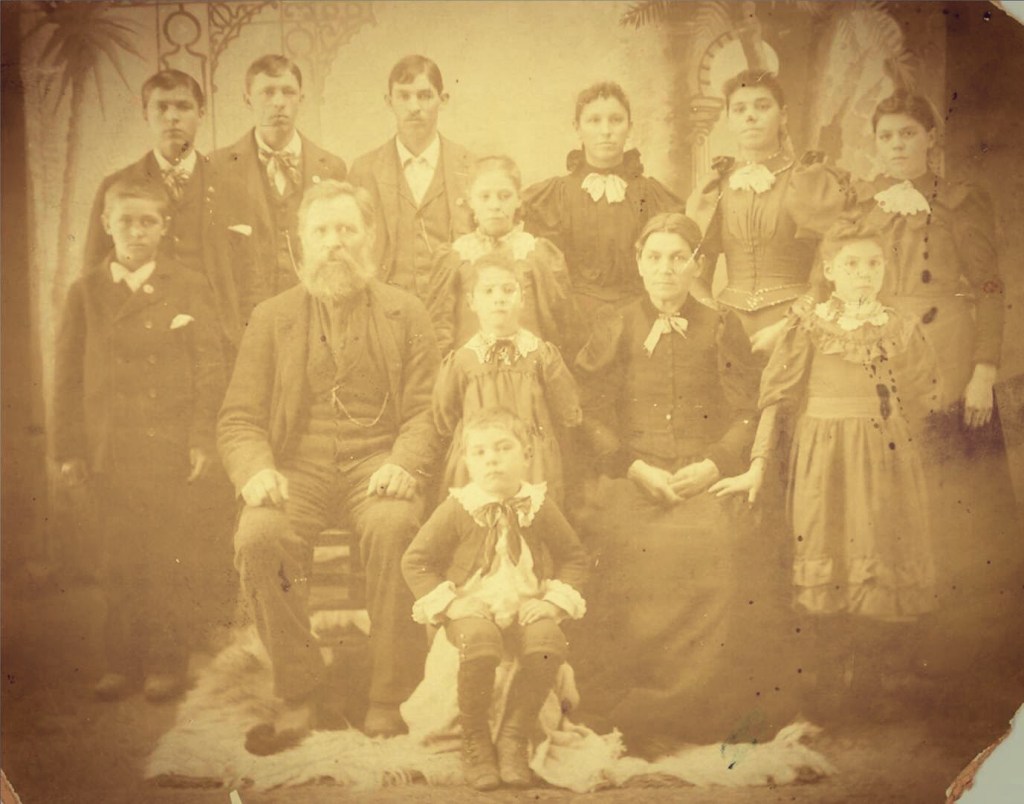
As the family grew in size and strength, and the farm grew in cultivation and corn, her little body rested on a hill that allowed on a clear day a view of the church steeple in the distance. Hers was one of the first—but not the last—graves to be dug in the sod of that country cemetery. Soon enough, she would have company, as do all those buried in the earth.
On a recent day in October, with an overcast sky above me and rain sprinkling on me, I walked that same cemetery, searching for the grave of the little girl that the family called “Mary Cornelia.” Of course, now the cemetery covered a much wider space than it did when “Mary Cornelia” was laid to rest there. Row by row, I walked through the wet grass and upon the black dirt of Nebraska, starting in the old section and moving through newer tombstones, but none carried the name of “Mary Cornelia.” Soon enough, I did find a tombstone marking her uncle’s grave. He had died on October 20, 1909. His was a strong and sturdy monument, still standing upright and tall, no etching upon it marred or scratched away by those winds upon the plains. But the years seemed to have erased any similar sign of “Mary Cornelia’s” sleeping the eternal rest on that same hillside. But still I felt it in my bones that she was nearby.
I was right. A few days after I had left Nebraska and had returned to Texas, I decided to call the Church Office in Humphrey to see if their records might confirm that “Mary Cornelia” was laid to rest there. I told the person on the phone that I had very little information to go on, only that her name was “Mary Cornelia” and that she had been born on September 9, 1877 and that her parents were Bernard and Petronella Wilde. Within minutes, the woman told me that she thought she had found a record in an old and musty parish book, although the name did not match the one I had said. She said the church records showed there was a burial of a baby girl with the same birthday in the church cemetery on September 24, 1877, but her name was not “Mary Cornelia.” Her name was Anna Maria Cornelia. Any doubt was removed that it was the same “Mary Cornelia” when the woman said the records noted the parents to be the same as I knew “Mary Cornelia’s” to have been.
With this knowledge and with a brief internet search, I was able to piece together another part of the puzzle. It seems that Anna Maria Cornelia was named after two of her mother’s sisters, “Marie” and “Anna” and after her grandmother who was named “Cornelia.” Her name was chosen because of these three relatives. Now, I had my great-aunt’s full name—forgotten or maybe never known by her siblings—and I knew why her mother had selected this name for her daughter. Anna Maria Cornelia was no longer a cloudy and inaccurate memory in the history of the family. She was real and her name and her place in the family now was made right after 142 years.
Of course, still unanswered and not to be answered by any of the sources is the question of why Anna Maria Cornelia should live for such a short while upon the Nebraska prairies. It seemed to me to be brutally unfair that the first child born to her parents as they started their new life in that place should die within two weeks of her birth, surely taking with her some part of their optimism and a big part of their dreams for a better life. And how, I wondered, did they pick up the pieces and plow the furrows in that sodded ground the next day? I only had found the answers to the easy questions. The difficult ones would remain a mystery.
On that single night that I spent on the Nebraska prairie I noticed as I stepped outdoors that the stars shine so brightly in the skies above those plains—even now with motel lights and store lights around me. And I knew that my great-grandparents stared at those same stars through the slats in the door of their sod house in that same place many years ago. I have to believe that the flicker of those far-away stars offered them a way to live without their daughter, Anna Maria Cornelia, who had died on the prairie and who had taken with her the promise made by those Great Plains of a better life.
For she, like the stars that shone overhead them, was a flicker of light. They saw the flicker for the brief moment that she was with them. And when the flicker went out, the familiar darkness appeared around them again. Yes, there was much for them to lament in the loss. But how beautiful to them the memory of the light when it had shone for that moment!
—Jeremy Myers

 Sunday Brunch