I admit I saw the backpack before I saw the back of the boy. Actually, I saw the three or four pieces of paper in the backpack before I saw anything else. For some reason they caught my eye—pages that looked like coloring sheets for a child. And they were partially colored, as children do, with the markings of the crayons going all directions on the page, no regard for keeping them within the lines of the drawing. The carelessness of the young, we could say, or is it the carefreeness, not yet bound by convention or constraint, left to move the crayon across the page, leaving a burst of color not unlike the rising sun that also knows no boundaries?
I cannot say exactly what the drawings on the pages were because I was not close enough to see the details, but I believe they had something to do with a Bible story or two since the boy had come from Sunday school. This was the reason for the backpack. By the look of the disheveled pages crammed as they were in the backpack, it’s a safe bet that the boy had put them there. Again, a boy is not bothered by the business of big people who like to sort and stack and staple pages.
As I looked at the backpack, I thought it an unusual one, although it may have been ordinary to another onlooker. I no longer have a need to shop the aisle for backpacks, so I don’t know what all is available. I can go only by what I see on the backs of children on their way to school. The first thing that struck me was its size. This one was small, but then the boy was small—no more than three years old by my guess—and so the size was just right for him to carry on his back. As he would grow up, so would the backpack, until one day it would be bulky and bursting and ballooning with hardcovers and contraptions and computers like a sow about to litter her young. Doubtless the crayons would disappear with the years, as would the freedom to color outside the lines. But for now, this miniature backpack was well-suited for the little guy.
There was another odd thing about the backpack. It was vinyl, unlike the canvas ones I ordinarily would see on a school child’s back. And more unusual still—to me—the vinyl was see-through with several colored stripes at the top. In time, the teenage version of him would not abide the transparency, as if the visible contents would reveal something of his soul to the stranger or to the in-group. I saw that the straps on this small person’s backpack also were bright blue, like strips of the blue sky across his light colored shirt. Its clear transparency invited my curious eyes to look at its contents—and there I found those crayon-colored pages that told the stories of heroes of the Bible to this mind still too young to read of the giants of old, but still able to learn of their heroics by coloring their features on the page.
I thought more about that backpack than perhaps I should have, but it was a choice of deciphering the color book characters or commanding my ears to collect the scattered words of the preacher in front of me into some coherent content. I chose the colored pages because they were more interesting and less taxing on the mind. Had I had caffeine in a cup or in a can, perhaps I would have chosen the other. Perhaps. Simply stated, I was finding the sermon in that small boy’s backpack feeding my soul with stronger sustenance than the sing-song sentences of the speaker standing before us speaking of the Scriptures with the same sensitivity he would have used to read a sales bill.
I remembered when I was small, as small as that small boy scooting around in his church seat, and I reflected on how it was to be small and how it was to be small in a big world and how nice it was to use crayons instead of computers. My memories moved with the same randomness as the preacher’s monologue—perhaps I was following his lead. One thing always leads to another thing as my memories were unlocked from the vault of history and allowed to have a few minutes in the sunlight, like a prisoner let out of solitary confinement for a half-hour in the prison courtyard.
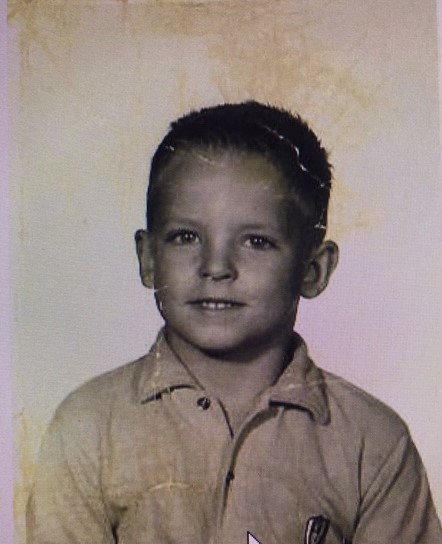
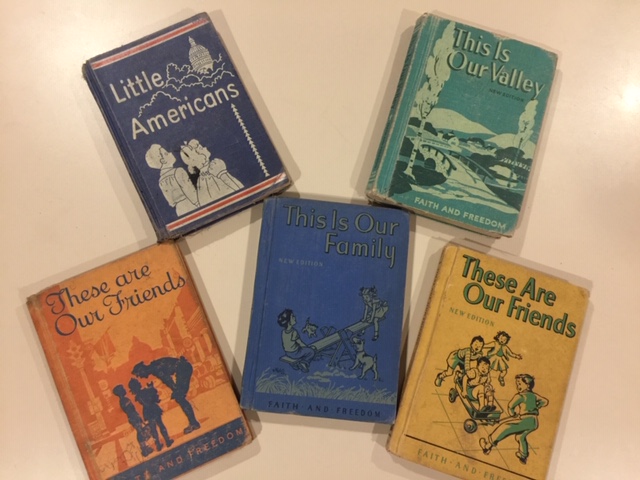
And what were those memories now released and allowed to walk in the fresh air? I thought of my crew cut and my blue shirt and my little desk. I remembered my first grade Dick and Jane reader and the daily reciting of the pledge of allegiance and the tiredness as the morning moved to afternoon and the end of the school day still was not in sight. But most of all—as I looked at the split-screen of then and now–I remembered I didn’t have a backpack when I went to school. It was no privation, just the plain fact that they weren’t a part of school gear then as now.
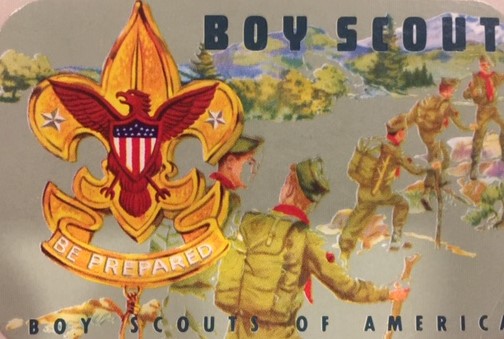
In fact, there was no kinship between a backpack and school when I was walking into that first grade classroom. For the small me, a backpack was a part of a soldier’s gear or something for scout camp outs. And because I would be soon enough a scout, I would have the standard army green backpack every scout had that held a mess kit and the basics for starting a campfire. The backpack helped us scouts in our efforts to be prepared, as the motto went and as it still goes. But that wilderness experience would not be until a few more years.
Still, when I started my schooling in the first grade, my grandmother sewed me a book bag. I don’t remember if I asked for it. I doubt it because I don’t think my little mind could have imagined such a thing. Rather, I think she saw me struggling with my small stack of school books. My grandmother always was sympathetic towards my needs, whether that was an orange crush soda or sugar in my coffee (yes she allowed me to have caffeine) or my own chair at her snack bar. It was nice to be somebody’s favorite. And who better than Grandma’s?
My grandmother was born on a prairie in pioneer days and so she learned to sew because it was a necessity for those times if a person wanted to be clothed and warmed and protected. Along the years, she had sewed a good many things as she raised her seven girls and five boys. I saw a needle and thread in her hands as often as I saw rising dough and bread pans in them. Once a necessity, it was difficult to let go of. She always was stitching or patching or quilting. It was what her fingers were taught to do.
So, it was a small step for her to stitch a school bag for me. I stood beside her as she sat on her chair at the sewing machine, with the little light on the machine shining bright on the material that slowly would become my school bag. The material she used was coarse—an intentional choice—so that it would be strong. For some reason, she used purple thread. I’m assuming it was close at hand, or maybe she liked the color purple. She sewed a small strap, just big enough to wrap around my shoulder. She added a pocket to the front. I think it was for my pencils and my crayons. At most, the school bag held two books, maybe three if they were not thick. But books always were thin for first-graders. I wish they were for grown-ups also.
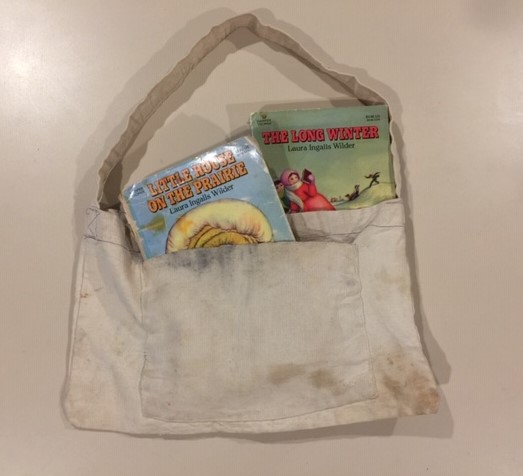
I still have that school bag these sixty years later. I can’t explain it really. After I had outgrown it —probably by fourth grade—I held onto it and stored it away somewhere safe, which is saying something for a boy of so few years. I never lost it and I never threw it away with the other stuff of my childhood. That safeguarding speaks as much to my sentimentality as to the strength of her stitches. I am not ashamed to say that I am as proud of it now as I was of it when she lifted the metal stitch guide and released the book bag from the sewing machine. As she put that new and beautiful thing into my hands, I still can see my smile and my shiny eyes, neither ever again as bright as they were in those days of childhood.
I wonder if that small boy in the pew in front of me will remember in the same way his vinyl backpack and how he stashed his Bible story coloring pages in it and how proud he was to be old enough to go to school just like the big kids. I hope he does. Although his backpack probably came from Walmart, still it is his first one, and all firsts are worth remembering, as are all lasts when that time also comes.
As parents know today, backpacks are ubiquitous, which means they are everywhere. They now belong to school children more than they belong to soldiers or scouts. As such, they are an essential part of going to school in the Fall. The trip to Walmart or Target or K Mart to find a backpack is also de rigueur. For most students, the backpack is a statement—signified by color, type, and decals. If it should come without advertisement or allegiance, it is easy enough for the enterprising student to use the blank canvas to create his or her own statement in the tradition of original artists such as Michelangelo or Picasso or a contemporary street artist. Like tattoos on the body, the add-ons to the backpack like to tell a personal story.
Because of the importance of these backpacks to the student’s school experience, our local church community some years ago decided to assist low-income families in getting school supplies for their children’s new school year. We called the effort “Back-to-School with a Backpack” and we were urged not only to buy a backpack, but to fill it with the necessary school supplies.
The response was amazing. We saw almost 800 backpacks bought, as well as innumerable carry containers filled with pencils and paper, crayons and notebooks, rulers and erasers, and just about anything else a boy or a girl would need for the new school year. Parents and non-parents alike participated, which suggested high interest and great generosity. Older people were heard to say how the shopping trip for school supplies brought back many good memories of their days as young parents with school-age children.
I tell you it was quite a sight to see all those backpacks laid out on the floor of the Family Center as we prepared them for delivery. The thought of the children selecting their backpack from the wide assortment brought happiness to everyone who helped with the project. And there were supplies enough for each child for the entire school year. As I saw all those backpacks, I hoped they brought as much pride and purpose as did my little school bag so many years ago.
Granted, my simple school bag made no statement as so many of these new types do, nor did it have the flash of these new ones, but it always will be special to me far beyond its usefulness. As I look at it today, I see there is a slight stain–maybe more than one–on the front pocket. I don’t know where they came from. I could wash it, but that would be as profane to me as washing the Shroud of Turin. I like to think that my grandmother’s fingerprints still can be found somewhere on it. I know her hands touched it many times as she sewed it on her small sewing machine and I always considered hers to be holy hands. So, I suppose I will keep the stains on the pocket in the same way the Resurrected Jesus kept the scars on his hands.
I don’t have a picture of myself with the book bag. I wish I did but iPhone was not a thing back then and cameras were used only for very special occasions, since the roll of film had to be mailed to the photo shop in the big city because photo shop on a personal computer also was not a thing back then. It also cost money to have the film developed. Great minds had not imagined photo paper or PCs in those ancient times. As we say, times have changed.
The change was no clearer to me than this past Fall when I saw still another innovation on the backpacks that children carry into schools. Now, reflecting our times, some school districts decided to include in their school supply list bulletproof panels that slip into student backpacks. I listened as school officials explained that these panels would be a tool to protect children in the event of a shooting. I read that a company that specializes in body armor now makes these bulletproof inserts for backpacks, although the experts say these inserts may give peace of mind, but do not give safety.
I’ve also learned that a company in Massachusetts by the name of “Bullet Blocker” not only offers these specially designed bulletproof backpacks, but also similarly designed clothes and notebook binders, all of which are made to stop a bullet from hitting its target— in this instance, a child. It is difficult to imagine a back-to-school shopping trip that now must include finding bulletproof backpacks for children. We have come a long ways in a short while since my 7 1/2 inch by 12 1/2 inch cloth book bag that would not have stopped a paper airplane much less a flying bullet.
I think there are times when it is good for us to pause and to reflect on where we have been, and where we are, and where we want to be. If these times are not just such a moment to ponder who we are, and who we have become, and if we’re alright with all of it, then when? Do we really want our children’s backpack to have to be reinforced with bulletproof panels? Is this the memory we want our children to have of their early school years? When did our schools become an issue of security instead of an issue of studies? These are the questions I ask myself.
As my mind goes back to the small, see-through backpack that the little boy in front of me in church carried that was just big enough to hold his colored papers imprinted with Bible story characters who had fought evil in their day, I am left to wonder if we have lost our capacity to fight evil in our day. Cannot we find the courage to challenge the evil among us that would compel us to turn our children’s backpacks into a body shield so that they might be safe? Are we to accept that students must carry backpacks for safety just as soldiers do?
So, I will keep my homemade school bag as a memory, not only of my grandmother’s love, but also as a reminder of better times when school children only had to fear their report cards, not for their lives. As I think back on that afternoon when my grandmother sat at her sewing machine and made my little school bag, I know she could not have imagined how a simple school bag would have to change to meet the needs of tomorrow. Nor could I. Nor should any of us.
—Jeremy Myers

 Sunday Brunch