“Between us and you a great chasm is established to prevent anyone from crossing who might wish to go from our side to yours or from your side to ours.” (Luke 16.26)
A rabbi remembers the moment he found his calling. It happened the summer he volunteered to help on a building project in Ghana. He lived for two months in a tiny village without electricity or running water. The night before he was to return to the United States, his friends gave him a going-away dinner in a small restaurant in Ghana’s capital city, Accra. When he got out of the taxi, it was raining and the air carried the smell of burning trash.
As he moved towards the restaurant he saw a young girl lying by a sewer. He saw her distended stomach and jaundiced eyes. Lying there in the rain, she barely moved. She looked up at him and their eyes locked. He froze. Seeing this young girl dying by the sewer, he said, felt like he was seeing the demarcation between God’s dreams and our actions.
His friends grabbed him and pulled him inside the restaurant. By that point, he had lost his appetite. When he went back outside, she was gone. He didn’t know if someone had saved her or if she was swept away in the muddy stream. He says he is still haunted by the sight of that starving child. And it was there, he says, that he knew he had to become a rabbi. He had to do all in his power to bridge the gap, to cross the chasm between oblivion and redemption.
Today another Rabbi tells a similar story. Rabbi Jesus speaks of a man with plenty to eat and another man outside his door with nothing to eat. The first one is unnamed, which is a warning to us that any of our names could be inserted. The second one is named Lazarus. The Rabbi’s story again paints a picture of a chasm between the two men. We find here all the dividers that we humans like to use to put a wide space between us and them: wealth and poverty, fancy clothes and rags, a nice house and no place to call home, the privileged and the unprivileged. Again, all the demarcations we build between God’s dreams and our actions.
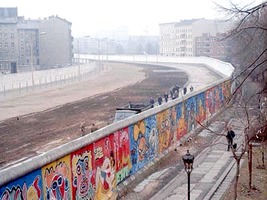
And as is the same with any wall, there is a willful failure to see beyond the wall that divides one man from the other man. The Rabbi from Galilee tells how the rich man turned a blind eye to the poor man and would not give him so much as the scraps off his table. The man with everything even failed to notice the man with nothing was covered with sores that the street dogs licked. Insulated and sheltered behind the walls that the rich man had built, he saw nothing, although the dying man slept outside the door to his house–just a few steps away.
According to the Rabbi, the sin was in the building of the wall. With the wall as a barrier between the two men, the rich man did not have to see the poor man. And in not seeing the other man, the rich man did not have to harbor the unpleasant and unsettling thought that maybe–just maybe–the poor man had the same worth and value as he did. Had he allowed the wall to come down, the rich man would have seen that the poor man was a real person, a human being, a man who also needed food and drink to survive.
Many years later, still another Jewish man, this one called Shylock, spoke the same truth in Shakespeare’s play, “Merchant of Venice,” when Shylock challenges the false premises of a chasm between Jew and Christian. He asks, “Doesn’t a Jew have eyes? Doesn’t a Jew have hands, bodily organs, a human shape, five senses, feelings, and passions? Doesn’t a Jew eat the same food, get hurt with the same weapons, get sick with the same diseases, get healed by the same medicine, and warm up in summer and cool off in winter just like a Christian? If you prick us with a pin, don’t we bleed. If you tickle us, don’t we laugh? If you poison us, don’t we die?” (Act 3, Scene 1)
Those are the questions that a wall doesn’t want to hear, the words that a chasm tries to stop before they can be spoken, the thoughts that a divide tries to ignore so that the lie can continue to live–the lie that there is a fundamental difference between us and them, that we have more value than they have, that we don’t need redeemed as much as the next guy.
Today, the story the Teacher tells us is not just a story. Lazarus still has his back against the wall. Wherever or whoever he is, he is still the same Lazarus–dispossessed, disinherited, disowned. And why? Because he is poor, and because he comes from another place, and because he is a person of color, and because he speaks another language, and because he is gay or lesbian, and because he is powerless, and because he is hungry, and because his body is diseased, and because he lives across the tracks.
The Galilean Rabbi ends with a warning for us who live behind walls where our willful blindness gives cover to our sins. He says the walls that we build between us and them will become the walls that separate us from God in eternity. Because we chose to put a chasm between us and those many others whom we did not deem worthy of a shared humanity, God will allow that same chasm to exist in eternity. But there, the rich will be poor, and the poor will be rich. The first will be last, and the last will be first. Abraham says to the Rich Man upon his death, “Between us and you a great chasm is established to prevent anyone from crossing who might wish to go from our side to yours or from your side to ours.” Our choices, it would seem, follow us to the other side of the grave.
Our saving grace, our salvation, says Yeshua bar Yossef, comes when we tear down the wall, when we allow ourselves to see those we have put on the other side of the wall as people with dignity and worth equal to our own, when we lower the drawbridge over the moat so that we can feed Lazarus and attend to his wounds. I met a living example of just such a bridge builder a few years ago. He was a young man in his early thirties. His day job was coaching young athletes interested in baseball. But he saw he had another calling as well.
Everywhere the man went he carried water bottles in the back of his pick up truck. Whenever he passed a person on the street or on the side of the road who looked down on his or her luck, he would stop to offer that person a bottle or bottles of water. The young man would take the time to ask their names, how they were doing, and if there was something else he could do for them. This man had done it for so long that he didn’t even consider it unusual. It was just something he did for the next guy.
Yet, at the same time that man was refusing to allow a wall to divide him from others who had less than he did. Instead, he crossed the chasm. Always, he saw the other person as a person of worth, a person of value, even if he or she didn’t have a dime to their name. He recognized Lazarus as he sat on his doorstep. And in that way he removed the demarcation between God’s dreams and our actions. That also was the way of the Teacher from Galilee.
In the end, each one of us must decide if the wall stays or if it goes, just as that young man did. And as we move towards that decision, we may want to remember the words of the American poet, Robert Frost, who wrote, “Before I built a wall I’d ask to know/ What I was walling in or walling out,/ And to whom I was like to give offense./ Something there is that doesn’t love a wall,/ That wants it down.”
— Jeremy Myers

 Sunday Brunch