“You cannot serve both God and mammon.” (Luke 16.13)
When the Roman city of Pompeii was layered with lava from the explosion of the volcano Vesuvius in the year 79 A.D., the residents had minutes to escape. Most were buried under the molten ash. Their lives were cemented at the moment of the eruption of the volcano. The city was excavated in the 18th century and a snapshot of life in ancient Rome was uncovered.
Among the many ordinary lives that were uncovered were the skeletal remains of a rich woman. She was in her garden and she was clutching in her hands a box of expensive stones. It was apparent that when the volcano spilled its lava onto the city, the first thing she did was grab her precious stones. Then she made a run for it. Unfortunately, that delay of minutes cost her her life. While she thought her wealth would save her, it doomed her.
That woman at that critical moment was confronted with an “either/or” situation, but–like so many of us–she tried to turn it into a “both/and” situation. She thought she could have both her life and her wealth. But it didn’t turn out so well for her. Nor does it for us all that often, although we still like to avoid those decisions that require a clear “either/or” answer. As the old expression goes, we like to have our cake and eat it also.
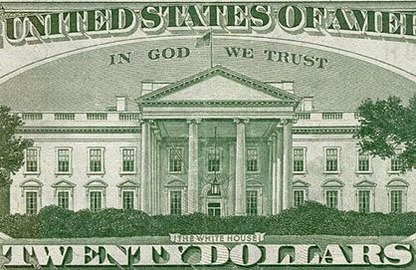
Because of our “both/and” mindset, we are going to have a difficult time with the Galilean Teacher’s words today that put an “either/or” choice before us. He tells us, “You cannot serve both God and mammon.” He tells us we have to make a decision for one or for the other. We can’t have it both ways. Without a doubt, he would find the words “In God We Trust” that we stamp on our coins and dollar bills a wrong-headed attempt to have it both ways.
As we all know, so much of our day is focused on money. We go to work to get a paycheck. We use our paycheck to provide us with food and shelter and clothing. If there is anything left after ordinary expenses, we try to put some money aside for a rainy day or for that day when we don’t have a paycheck. Just about every moment of every day is built on money, whether it is the electricity we use, or the car we drive, or the sporting events we attend. Money is an integral part of our lives, so intertwined into our day that its removal would bring everything to a standstill.
So, we’re left to ask just why Rabbi Jesus would put that “either/or” choice before his followers. Either God or money. But not both. Why in the world is money such a deal breaker for the Teacher? For an answer, we need to understand that the Rabbi spoke about money often–more often than any other topic. And when he spoke about it, he spoke about its dangers. He saw in money some of the darkest expressions of the human heart–greed and avarice, disunity and division, false security and misplaced priorities.
The Galilean Teacher juxtaposes the two–God and money–because he sees that money is never neutral for us. It always carries another value or set of values beyond just its numerical worth. Looking around him, the Rabbi saw that money was used as a way to gain power, prestige, or position. It allowed people with it to put themselves above others, or to control others, or to distance themselves from others. It always separated those with it from those without it.
Here, as always, the Rabbi shows a keen understanding of the human heart and what lies deep within its recesses. He knew that it is within our heart that we make our life decisions, either for good or for evil. And so often, the many ways we use or think of money speak in crystal clear words those dark urges of the human heart. He would agree with the contemporary spiritual writer who said, “The ways that we earn, spend, and invest our money may have more sin in them than anything else we do.”
So, when the Rabbi asks his followers to make that radical decision–God or mammon–he is asking us to open our hearts to good, which is the way of God, not to close off our hearts to good, which is the way of mammon. It makes sense, then, that within a short while we will meet the rich young man to whom the Rabbi says, “Go, sell what have, and come follow me,” and who then walks away sad because he cannot let go of his many possessions. Or, in a similar way, we will hear the Rabbi tell the story of the rich man who showed no compassion to or concern for Lazarus, the poor man who sat at his gate, starving to death. The rich man ends up in the dark abyss, while Lazarus rests on the bosom of Abraham. It is the same message told another way. Either God or mammon. You cannot serve two masters.
For many years, Bill Gates was the richest man in the world. He once told a reporter, “I wish I wasn’t. There is nothing good that comes out of that.” Sometime later, Gates decided to give away his fortune. He said, “Well, if you have money, what are you gonna do with it? You can spend it on yourself. You can have, you know, thousands of people holding fans and cooling you off . . . But we didn’t have any consumption ideas.” Instead, Gates and his wife, Melinda, set up a foundation with a pledge to give away 90 percent of their wealth. They invited other billionaires to make a similar commitment. The foundation now has over $50 billion in assets that are used to fund multiple projects for good and for eradicating poverty and disease across the globe.
That is the same lesson that the Galilean preacher asks us to learn, each in our own way. He wants us to see that the human heart thrives on giving, which is the way of God, not on getting, which is the way of mammon. Today, he asks us to look into our hearts and to give him an answer. Will it be God or mammon? Whatever the answer we give him, it cannot be “both/and.”
— Jeremy Myers

 Sunday Brunch