“Your brother was lost and has been found.” (Luke 15.32)
A handful of years have gone by since the man died, leaving behind two sons. And however long the discord between the sons and whatever the first cause of the distance between them, it did not end with the death of their dad. The younger son made all the arrangements for the burial of their dad. And he walked alone behind the casket as the man’s body was brought into the church. It was assumed by that point that the older son would be a no-show.
As the small procession made its way down the aisle, a lone figure rushed in the doors at the back and broke to the left as he made his way into the last pew. It was not a quiet entrance. Who he was did not become clear–at least to me–until he shouted loud enough for all the mourners in the church to hear. The words that he shouted with venomous hatred were, “I won’t sit anywhere near my brother.” And so it was as the funeral of the man with two sons proceeded. The younger son sat in the first pew of the church. The older son sat in the last pew of the church. And the space between the two sons was so wide that even the death of their father could not bring them together for one hour.
The cause of the impassable distance between the two sons was never told to me, but it did not matter because it is always the same cause, whatever the different circumstance. There is an evil inclination in the human heart that would have us see our brother as our enemy and not as another son who also shares in his father’s love. Today the Jewish Rabbi named Yeshua bar Yossef tells us a similar story of a man with two sons. The reason for the story is the same as before. “Tax collectors and sinners were all drawing near to listen to Jesus, but the Pharisees and scribes began to complain, saying, ‘This man welcomes sinners and eats with them.'” Distance. Discord. Disharmony.
We see there the ubiquitous shadow of the Biblical serpent as it sneaks into the human heart one more time, its bite always poisoning the primal bond between brothers, a brotherhood that was put there by the Father of one and all. The snake slithers through the pages of the Sacred Texts, scaly and sinister, seeking a singular delight and destination–disharmony. From start to finish, the serpent slides surreptitiously into the souls of humans, spilling within these sin-proned persons its venomous poison that drains the last drop of light from within until there is only a deadly darkness that destroys the first principle of life, which is to love one another.
Always within these holy pages with this unholy shadow, there is one question that haunts our thoughts and shatters our hopes for a better tomorrow–why does brother hate brother? The answer, it seems, is found in that sinister snake that has its fangs embedded so deeply into the human heart that hatred bleeds out from it more than love. Somehow, the serpent has sold us a bill of goods that we are better suited for hatred than for love. Sadly, we have been eager buyers of the lie.
So, it is no surprise, then, that the question is asked of us to answer again by the Galilean Teacher who starts to tell his story with the ominous statement, “A man had two sons.” It is sure to end with sadness because we have seen these same sons elsewhere in humanity’s history: Cain and Abel, Jacob and Esau, Joseph and his brothers, Absalom and Abmon. We will see it soon enough in Judas and Jesus, who knew his betrayer first as his brother. And, always, the stories of two sons ends with the same sad sight–a father with tears etching his cheeks because he loves both his sons. Therein is the tragedy–while hatred fills the human heart, only love fills the divine heart.
We listen as the Rabbi puts before us this story of these two sons, a story of rivalry and resentment and rancor, and pettiness and past grievances and pointless arguments, and cold-heartedness and close-mindedness and cowardice, and selfishness and stupidity and sinfulness. Yet, in the mosaic and morass and mud of this swamp of sin still stands one stately figure–the Father who loves both his sons because his heart has enough love to embrace not just one, but the two of them. “My son,” he says to the older one, “you are here with me always, everything I have is yours. But now we must celebrate and rejoice, because your brother was dead and has come to life again, he was lost and has been found.”
With those words the Father places before his first son the same choice he put before his first creatures–will you choose life or death, will you choose love or hate, will you choose to see one another as your brother or as your enemy. Or asked another way in our own times in the words of Rodney King during the 1992 Los Angeles riots, “Can we all just get along? Can we get along?” Again, right there is the question that always sits at the heart of the human story.
The answer, in simplest terms, is determined by our strength or our weakness against the power of evil. Do we have the necessary resistance to the slow poison of death that the conniving snake in the grass carries in its bite? Notice that the Rabbi doesn’t tell us if the older son enters the banquet to celebrate his brother’s return, or if he chooses to stay outside, resentful and removed from the fraternal bond. We can assume the Teacher wants us to answer the question. The answer we give will come in how we live our own lives.
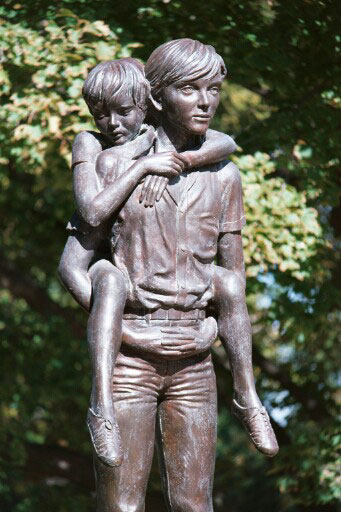
A century ago, an Irish priest in Omaha, Nebraska opened a home for troubled and neglected children. He called it Boy’s Town. A year later, a young boy named Howard was abandoned by his mother at Boy’s Town. This boy had polio and wore heavy braces on his legs, which made it difficult for him to walk, especially on steps.
Soon, some of the older boys in the home started carrying Howard up and down the stairs. One day, Father Flanagan observed one of the boys, Reuben, toting Howard on his back as the two climbed up some stairs. Father Flanagan asked Reuben if carrying Howard was hard. Reuben answered, “He ain’t heavy, Father. He’s m’ brother.” In time, those words became the motto for Boys Town because they best described the mission of the orphanage. They also best describe the mission of those who choose to follow in the footsteps of the Galilean preacher. He ain’t heavy, Father. He’s m’ brother.
If, in fact, we are his followers, then the story the Teacher told us should end in this way. The older brother, seeing his younger brother beaten and bruised by life, picked him up as he lay on the ground, and he held him in his arms as the younger brother struggled to stand. The older brother said, “Here, let me help you into the house. We have a big party planned for you. You can’t imagine how much I’ve missed you every day that you were gone. I love you, bro.” And the two brothers, one held in his arms by the other, walk into the house together, where their father waits for his two sons, a smile on his face.
— Jeremy Myers

 Sunday Brunch