Orthodox Jews want to rebuild the Temple of Solomon in Jerusalem. Most would say it is a pipe dream. Other believers take the view that the Messiah will rebuild the sacred structure when he comes. Until the Third Temple is built one way or another, a partial wall from the Second Temple still stands on the old site. It is a stark reminder to the Jewish people of something that once was a visible symbol of the Deity they worshiped. It also reminds them of their identity as a people once chosen by God to be his special possession. While the Western Wall still serves as a sacred spot for the Jewish people, it also is a sad reminder of what was and what–more likely than not–never will be again.
If you drive Texas Highway 277–a 633 mile road that runs north and south across West Texas and crosses over into Oklahoma–you see many signs of things that once were and things that never will be again–including towns, schools, and churches. On a stretch of the road 11 miles outside Seymour, as you move towards Abilene, you pass through one of those towns that just isn’t there anymore, or isn’t anything like it once was. The town is Bomarton. Maybe there still is a sign that tells you the name of the place. I don’t remember. There is a scattering of houses–not many–and a small grain elevator. That is about all that is left of Bomarton, Texas. Outsiders call it a ghost town, although I’ve never seen any ghosts there–just the ghost of what once was.
All the rest is gone–except for an empty church that stands stubbornly in place, its steeple a break in the big Texas sky behind it. Although it no longer serves any purpose, it dominates the landscape, visible for miles, a vertical monument on an otherwise flat plain. There is a rough side road off Highway 277 that takes you in front of the old church. The road is unpaved, just packed dirt, with potholes and deep grooves where heavy pick-up trucks left tire marks in the mud when the last rain came to these parts.
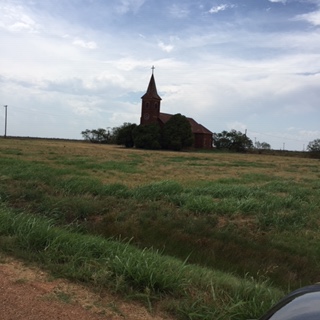
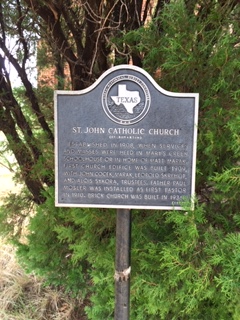
The area in front of the church has been commandeered by lifeless grass and an occasional mesquite bush that suffers visibly in the Texas heat. You can drive up to the front of the church–if you don’t mind a rough ride–and as you step out of your dust-covered car you’ll see a Texas Historical Marker to the left of the front doors. It indicates the church’s name–St. John’s–and the year it was built–1936.
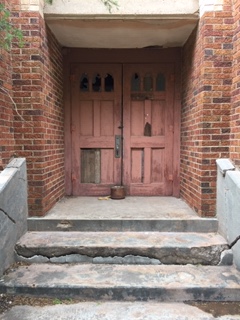
The wooden doors are secured by a heavy can of some sort. Long gone are any locks or knobs that worked. Move the can out of the way and the doors will creak open with arthritic moans. You step inside and you’ll find a guestbook, an old notebook of the school variety, an interesting and inexplicable item given the condition of the church. The second thing you’ll see is a hand-printed sign tacked to a wooden pillar of the church that lets you know–in no uncertain terms–that the church is now private property and if you’re up to no good, then move on. That sign also raises as many questions as the guestbook. I’m told that the guestbook gets a remarkable number of signatures. As to the people who are up to no good, there is no ascertainable number.
The one word that describes the abandoned church is empty. And as experience surely has taught most of us, empty is not a good word. In fact, in a more perfect world, “empty” would not be a word ever spoken. In this imperfect world, “empty” is a word too often spoken. The gas tank is empty. The house feels empty. My heart is empty. Just the sound of the word makes us suck in our breath. The opposite of empty is full. It has a friendly sound. My stomach is full. The room was full of laughter. My brain is full of good ideas. Full is a good word.
As you take those first few slow steps into the old church, not only is the space empty, but the air is empty. Lifeless. Not even any detectable smells. Once in a while a bird will veer off course and fly through the church, but it doesn’t stay long. Another posted sign–also homemade–welcomes the visitor who is seeking a place of peace, a place to pray, a place to ponder. Those sentiments seem better rooted in its past, not so much in its present day condition, although I will agree there is much to ponder.
At this point, a person surely is allowed to think of the title of the historian David Knowles’ book about the dissolution of religious houses during the reign of Henry VIII. He called his book “Bare Ruined Choirs.” You can see it before your own eyes, although you are far from Tudor England.
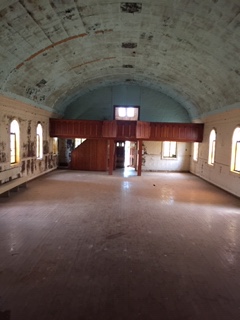
Once, as a young boy, I had visited the church. Our Boy Scout troop had a weekend camp-out close by, and the church was the closest one for the Catholics in the crowd. The years since then have not been kind to the place. What once was full is now empty. Where windows once shone with the full sun, panes now are empty in places. And where vibrant colors filled the space, paint peels from the walls leaving ugly empty spots. Even the pews that filled and gave form to the interior are long gone. There is nothing that remains where they once stood except emptiness. I think I know how the Jewish people feel as they stand before a crumbling wall and remember what once was there.
Bomarton was and is a farming community. Whereas there used to be many small farmers, now there are a few big farmers. According to the historical marker, the Catholic community had its start in 1908, although I’m confident there were settlers already there before that time. It got its name from a man named W.T. Bomar, although there isn’t anybody left who remembers anything about him, except he was one of the first to arrive there.
Historical records indicate that it reached its highest population in its early years with 600 people living there. As was the case in many other small communities, the town was settled by immigrants with roots in Europe. In this instance, specifically Czechoslovakia and Bohemia, when the two still were separate countries. Like their native lands, these people brought their Catholic religion with them. It was a big part of who they were.
That fact also explains how such a large and impressive structure could be built in 1936 at the height of the Great Depression. Despite such obstacles, the church was built, a testament to the conviction, the confidence, and the leap of faith that these old timers had in the marrow of their bones. It was that resolve that had brought them to this foreign country and it was that resilience that bolstered them when the winds of adversity knocked them to the ground. As a child, I remember hearing grown-ups around me speak of the stubbornness of the Bohemians in Bomarton. Now, I like to think of it as their determination.
I read once a collection of letters that a German immigrant had written back home telling his relatives about life in the new country. In one of them the man proudly spoke of the little wooden church that had been built for the settlers. He wrote these words in one of his letters, “This was our first church. After a while it got too small, and so we built the beautiful new church out of stone. For a while the old one served as a school. But the tower on the old one didn’t have to be taken down, a storm did that job for us. We still like to think back on those Sundays in the old church. It was the first one, and we built it with our own hands. There is where we heard the Word of God, and from there we received many blessings for our farms.” A farmer from Bomarton could have written the same letter to his family back in Bohemia.
Strangely so, the altars still stand in the church. Their presence is almost painful. Years ago, I knew an elderly man in Dallas. As chance encounters go, I learned he was born in Bomarton and had been baptized in St. John’s Church there. On a trip back in the early 1990s, he stopped by the church. By that point, it was no longer in use. For a while, a priest from Seymour would travel to Bomarton to say Mass on Sundays for the few people left there. A later priest decided to say Mass there only on the 5th Sunday of any month with five Sundays. The next priest stopped going. This was the state of things when the man from Dallas returned to the old church.
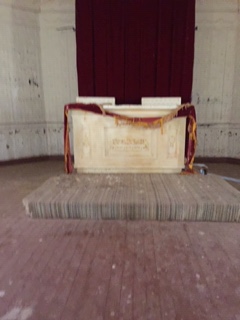
He saw the baptismal font that had been used for his baptism. Seeing no harm in asking, he drove to Seymour and asked the pastor if he could have it. The pastor said yes. So the man picked it up, put it somehow in his vehicle, and brought it back to Dallas. When I saw it, it was on his front porch. It had come a long ways from Bomarton and looked lost and forlorn on that front porch. I wonder where it went after his death. I know it is far from home.
The Hebrew Scriptures tell us that King David decided that he would build a temple in Jerusalem to the Lord God. As he explained it, “Here I am living in a house of cedar, but the ark of God dwells in a tent!” So the king made big plans. But he learned soon enough that the Lord God was not at all in favor of having a magnificent temple built in his honor. In fact, the Lord God spoke to Nathan the prophet in these words, “Go and tell David my servant, Thus says the Lord: Is it you who would build me a house to dwell in? I have never dwelt in a house from the day I brought Israel up from Egypt to this day but I have been going about in a tent or a tabernacle.” He continued, “As long as I have wandered about among the Israelites, did I ever say a word to any of the judges whom I commanded to shepherd my people Israel: Why have you not built me a house of cedar?”
In the end it would not be David who built the Great Temple. It would be his son, Solomon. The Temple of Solomon was the jewel of Judea. But as with all things ethereal on earth, it did not withstand the invasion of the Babylonian ruler, Nebuchadnezzar, who torn it to the ground in 586 B.C.E. The First Temple had stood for less than five hundred years. When the Jewish exiles were allowed to return home by Cyrus the Great of Persia in 516 B.C.E, reconstruction of the Temple began. Herod the Great would add to and complete the Second Temple before his death in the First Century B.C.E. That Temple was destroyed by the Romans in 70 C.E. When they were done demolishing the beautiful structure, nothing remained but a small part of the lower western wall.
Perhaps, then, it was with good cause that the Lord God told David he was content to stay in a tent. He understood the transitory nature of all things human. Perhaps, he also wanted it understood that he was just as much at home in all the universe as he was in a stone and mortar structure atop a hill in Jerusalem. Perhaps, he wanted his people to know his divine presence cannot be put behind lock and key.
It is difficult to say just how much longer the church alongside Highway 277 in Bomarton will stand tall against the Texas landscape. Certainly, it was built well for it to have stood this long, especially without any recent maintenance. But the windows are going and the roof will follow soon enough. In time, the mortar will crack and the bricks will crumble. Still, it will be a slow death.
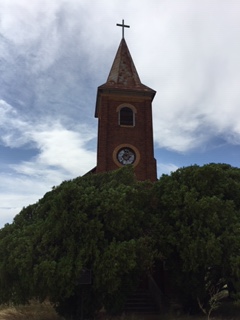
But so long as it stands, that stark steeple serves as a reminder of a strong people who put their trust in the God of the heavens, a God who sent rains upon the earth to water their crops, a God who looked down from his throne above with love for his children who now lived East of Eden. And surely he smiled upon the work of their hands and the prayers on their lips and the love in their hearts.
If we feel a pang of jealousy for these people’s faith, it is understandable enough. Would that we could find God so easily in our midst. We are left to wonder if God feels the same emptiness we do.
— Jeremy Myers

 Sunday Brunch