If you don’t mind 100+ degree temperatures, the place you might want to visit on the second weekend of August is Vernon, Texas. There, each year, you will find “Summer’s Last Blast.” The popular event has a thirty year history. What makes Vernon’s event special–aside from the heat, which is not so special in August–is the centerpiece of the weekend–old cars. Some people prefer to say “antique.” Others like the word “classic.”However, I believe “old” is a respectable term, at least in reference to cars, not women, although I know some men give female names to their cars. In that instance, perhaps “classic” is the better choice of words.
The city of Vernon advertises this event as “one of the longest drags of North Texas and Southern Oklahoma.” They invite interested persons to “relive the ‘GOLDEN DAYS’ [emphasis theirs] when True Muscle Cars and Rods ruled the streets.” If that doesn’t capture your attention, then maybe this line does, “See the most prestigious Classics, Street Rods, Pro Streets, and Antiques cruise the streets as they did in the Good O’ Days.” Now, since this cruise down the street is specifically for old cars, the event leaders note “all registered cars must be of 1978 manufacture or older.” I bet you didn’t think being born in 1978 would make you antique, except in the minds of your children.
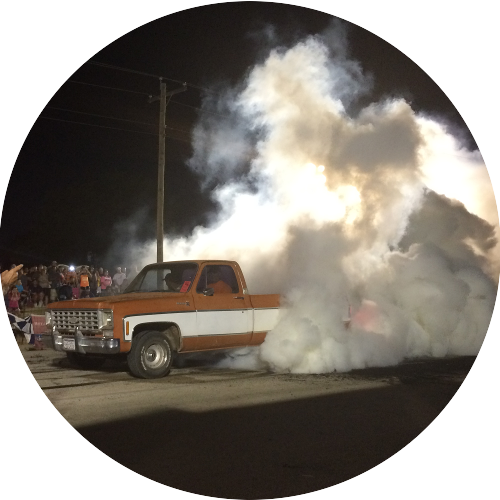
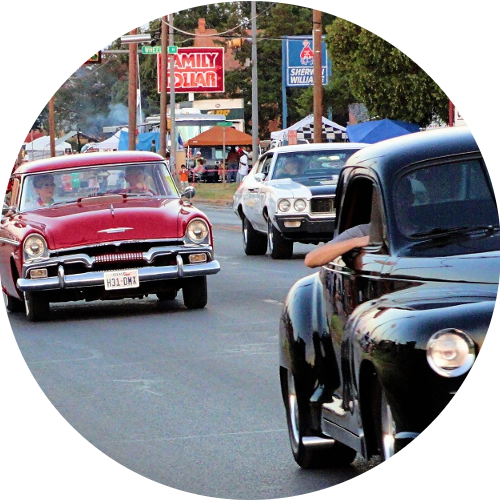
Still, it is a popular event, with the highlight being that “Nostalgic Cruise Night” where all the cars go up and down the blocked-off streets of Vernon, forming a line of cars that is considered the longest cruising of cars anywhere. Others, rightly, might say the big event is the “Burn-Out Contest,” advertised in this way: “If you like the sound of raw power and the smell of burning rubber, this is the place to be Friday night. Contestants are judged while they light up their tires and attempt to win the title for the Best Burnout. Watch as smoke and hot rubber fly all over east Vernon.” If you’re one of those people that doesn’t like the smell of burning rubber (why you would be in Vernon that weekend is beyond me), then there is plenty of smoke on outdoor grills where food and vendors of every sort rent out space on the sidewalks of Vernon so that people can sit and eat while they watch the cruise circle the city.
The event, I’m told, has become so popular that some residents leave Vernon for the weekend and leave the town to the visitors, much like residents of the Garden District in New Orleans hop on the first plane out of the city when the Mardi Gras drunken gangs hit the city for a last party before Lent. I’ve been there and–trust me–it’s no way to start Lent, with a hangover and no memories of the last 24 hours. Still, lots of Vernon locals stay in town, enjoying the summer heat and relishing the journey back in time. The popularity of that weekend, I believe, proves that there is something intrinsically intriguing about the past, not only for car connoisseurs, but to most people in general. Maybe I speak too broadly, but I don’t think so.
I confess that I have this recurring head trip of wanting to go back in time for one day. If that wish isn’t granted, then for a few hours. I don’t think I’m alone in that want or all that peculiar. Haven’t you, maybe, daydreamed about a “back to the future” experience? I have a sister who is an expert on Laura Ingalls Wilder, the little girl of the “House on the Prairie” book series and later TV Show that had a ten year run beginning in 1974, which qualifies the show as old or, should we say, antique. Michael Landon of “Little Joe” fame in the earlier TV series “Bonanza” is the main character. My sister got caught up in the books when she was an elementary school teacher and used the book series to teach reading to her students. Her children in the classroom ate up the books almost with the same fervor that they ate up the homemade bread that she would bring into the classroom as a demonstration of the food that little Laura ate while she was a girl on the prairies of South Dakota (I know, the TV show centered on her years in Walnut Grove, Minnesota, but my sister assures me Laura lived the first fifteen years of her life–give or take–in DeSmet, South Dakota).
My sister is such an enthusiast of “Little House on the Prairie” that she visited both places one summer. She wanted a first-hand, hands-on experience of Laura Ingalls Wilder’s life. She always said she would like to go back in time to “Little House on the Prairie,” and this was as close as she could get to doing just that–or until some time capsule comes along. She was enthralled by the experience, although the visit took some of the rosy tint off her glasses because she realized it was a much more difficult life back then than she had anticipated. Maybe the books painted too rosy a picture of prairie life. Historians don’t play as loosely with the facts. They tell us it was a very hard life.
My own travel back in time–were it granted–would be to go back to one of the first few years after the founding (1895) of the community in which I grew up. I don’t want an “Our Town” experience, wherein Thornton Wilder’s central character, Emily, who has died giving birth to her second child, returns to earth (as a spirit) to relive one perfect day, which was her 12th birthday. The play, I find, is almost too real and too sad because Emily ends the day by reminding us that every moment of life must be treasured because it ends too soon and it is taken too often for granted. Maybe the play has damaged me because I don’t care to go back to a day in my own life. I want to go back to a day long before my own life.
I think it would be fascinating to see something so simple as the type of roads that lined the community back in the old days. Whereas we now have asphalt-covered roads, they had dirt paths. I’d like to see the property where I grew up, just to know how it looked a hundred and twenty years ago. Did anybody live on it? Was it covered in buffalo grass, as much of the area was back then? I’d love to see my grandmother when she was a twelve-old-girl on her farm. We never think of our grandparents as young, but they were once upon a time. I’d want to see the horse and buggy they used to go into town. I’d enjoy walking into the old wooden church that served the community until twenty-five years later when a newer and bigger structure could be built. For some strange reason, I always imagine the community as darker back then, as if the sun didn’t shine in the late 1890’s like it does now. Yes, it’s ridiculous to think it didn’t, but I guess the idea of no electricity and no street lights and nothing but kerosene lanterns has convinced me that there was a dark cast over the whole world. Anyway, a trip back would help me sort out whether or not it was darker then than now.
Maybe I should have been a historian. They love the past. Or an archaeologist, although I’m not really into old bones (antique?) or digging into the dirt with a toothbrush. I think of the joke about the archaeologist whose wife said the older she got, the better she looked in her husband’s eyes. Although I am neither–historian nor archaeologist–I feel a pronounced pull towards the past. I don’t want to have lived back then–except for one day, as I said. My preoccupation with the past really has more to do with the present. I want to know how we got here. As I see it, just as a body grows and matures with time, so a community and so a country. Who we are as persons and as a people depend so much on who we were once upon a time. Our present is formed by our past.
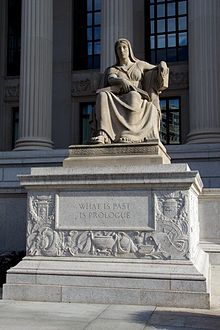
That idea, of course, is not a popular one for people who want to believe nothing and nobody existed before them, or who believe anything old is out of date, or who never think there are lessons to be learned from the past. There is an engraved slab of stone as you enter the National Archives Building in Washington, D.C. that says” The Past is Prologue to the Future.” The phrase purposely is placed in that location to make the point that history sets the course for the present. I admit I agree with that school of thought. A good many old people (I include myself in that bracket) hold the same thought. When a person has lived long enough, oftentimes there comes with the gray hair and the bad knees a wisdom about life. Not always, but especially to those who have experienced life and have allowed themselves to learn lessons from this strict teacher. The writer of the Book of Ecclesiastes, also called “the Teacher”, says “There is nothing new under the sun.” Old people tend to agree, only because we realize humanity as a whole doesn’t seem to learn well the lessons that life would teach us.
Admittedly, I find it interesting that both the Jewish and the Christian religions are built on remembering the past. The Jewish Scriptures continually issue the command, “Remember. ” For example, “Remember that you were slaves in Egypt and that the Lord your God brought you out of there with a mighty hand and an outstretched arm” (Deuteronomy 5.15). The Passover celebration, the annual and central celebration of the Jewish calendar, is a meal centered on remembering the slaves’ exodus from Egypt. Similarly, the Christian’s central celebration of the Lord’s Supper is rooted in the Jewish Rabbi’s instruction to his followers, “Do this in remembrance of me.” With such centrality of focus on the past, both these traditions would have us believe that vital lessons are there in the past for us. Like the tree of life that was planted in the Garden of Eden and that provided fruit that sustained the lives of Adam and Eve, so the past offers us fruit that will keep us alive so long as we pick from its limbs.
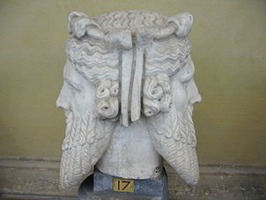
There is a popular TV advertisement that asks the question, “Can the past help you write the future?” The advertisement doesn’t provide us with the answer. Each of us, I suppose, will have to decide for ourselves. Here, I believe ancient mythology got it right. Janus–from whom many believe we get the month of January, not coincidentally–is the god of the past and the future. His image often was positioned above major doorways in buildings and in homes, a logical placement since we leave one place for another when we walk through a door. More interesting, really, is that the god Janus always is presented as having double-faces joined together. One face looks to the past while the other face looks to the future. The message in that representation, I believe, is that we have no future without our past.
So, I guess, I would argue that the “Last Blast of Summer”in Vernon, Texas is more than just an antique car show or an end-of-the-summer party. These old cars and the cruise down the streets of Vernon like they did in the 1950’s are clarion calls to remember the past, to honor it, and to learn from it. If we listen carefully to that call, I believe, the future looks a lot better for us. Paradoxically, we could say, it’s only when we look back that we can see ahead.
— Jeremy Myers

 Sunday Brunch