Play-Doh and I both were born in 1956. You can make of that whatever you want. I’ve given it some thought myself. The irony is I never played with play-doh as a child, although we were siblings. I didn’t meet my sibling until much later when introductions were made in my mom’s kitchen as she cooked up a batch of play-doh for the grandchildren.
My mom didn’t bother with buying the stuff sold in stores. She made her own. There was nothing wrong with the stuff in the store. But buying play-doh instead of making her own took away half the fun. Surely for the children. My mom had a natural instinct for raising children, which was good, because she had many of them. I never saw her pour over a page of Dr. Spock’s magnum opus, The Common Sense Book of Baby and Child Care, a guide for nervous and new mothers that was more popular than the Bible when she was having children. She already had what the book urged upon its readers–common sense.
As a result, she understood that children needed lots of unstructured time to let their brains expand and extend into all kinds of creative avenues. This approach, of course, is the opposite of the present mode of parenting, where children’s days are structured from start to finish, which may explain also why anti-anxiety medication is the most prescribed drug for college students. We, on the other hand, grew up with the freedom to explore tadpoles in a muddy puddle, design a house in a field of weeds (all we had to do was clear the weeds to make a room), and walk a mile to and from a nearby river to fish or to wade in the water (if there was any) or to make mud pies.
Granted, such unstructured time had some risks, such as the time my youngest brother and his cousin–probably 8 or 9 years old–explained to my mom that they had spent the afternoon shooting rattlesnakes with their bb guns. My mom, always grateful for guardian angels, offered a word of caution for their next adventure. She was a child psychologist without the degree, especially now that we read how psychologists are alarmed that schools are removing recess from the school schedule. The experts are cautioning how a child’s creativity is being crushed by the loss of unstructured time. My mom didn’t need to be told. She understood.
So, when grandchildren were in her house or she knew some of the great-grandchildren were coming to visit, she made sure that she had her supplies ready for making play-doh. Not that there was much needed in the way of supplies. She had found a recipe in a church cookbook that required a minimum of ingredients and she soon mastered the making of homemade play-doh, much to the delight of her grandchildren and great-grandchildren.
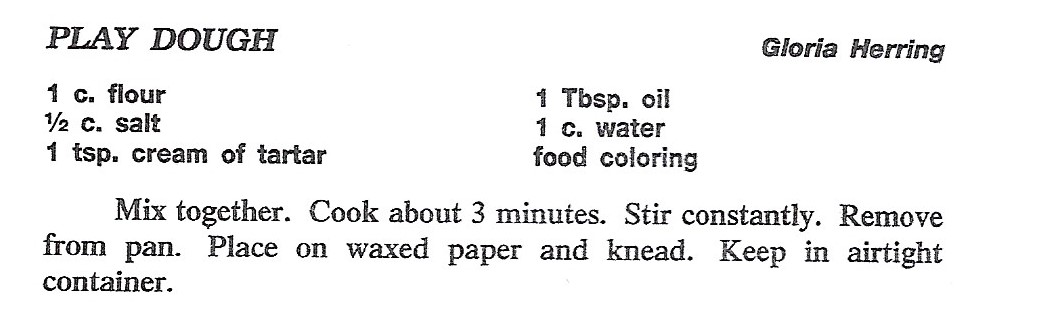
I can still see her standing at her stove with the big skillet over the flame as she mixed the ingredients and stirred up a new batch of play-doh. The kids were right there beside her. The greatest moment, of course, was when she allowed them to put in the drops of food coloring. They picked the color they wanted and she usually made several batches so that they had plenty of colors of play-doh. That also was a big part of the fun, after all, and was sure to prime their creativity.
When my visits back home coincided with visits from grandchildren or great-grandchildren, I would walk into my mom’s kitchen and find one or two or three or more kids busy as bees at a bench in her kitchen, using the play-doh as it was meant to be used–for anything that the child’s brain could imagine. I saw many identifiable–and just as many un-identifiable–creatures made from the little hands of children as they rolled and molded the play-doh into every imaginable shape and form.
It always was interesting to watch how gender put its mark on the artist’s creation, with boys often molding outdoor stuff and girls making indoor stuff. Not always, but often. My mom also provided cookie cutters that could be used to assist in the artist’s toil, with these cutters coming in many shapes and sizes. But more often than not, the children preferred free expression. They were more expressionist artists and less Renaissance. I enjoyed watching as these young minds expended great energy into creating their works of art, focused and diligent in the task at hand. They didn’t need a babysitter or continuous attention. They were busy with creation.
The other fascinating thing I observed was how easily children could start over. They could spend long minutes molding the play-doh into the form they wanted. Seeing it and showing it off once it was finished, suddenly they would squeeze the play-doh in their little hands and return it a round glob of nothing. Smiling and sweat on their brows, they started over, trying for another masterpiece with the same intensity they had showed for their previous work. They showed no hesitation in making a fresh start. There is a lesson there for older minds with greater years.
When my mom died, the one story that all the grandchildren reminisced about was her play-doh. It was right up there with her picnics (another story to be shared another time–see the upcoming “Life is a Picnic”). It was clear that those moments were some of the most memorable, as they recollected pulling up a chair to the kitchen stove and helping her make play-doh and then kneeling at the bench by her table and working with their fingers to turn the play-doh into something that would bring a smile to her face. My mom, unintentionally perhaps, was making memories for these children the whole while she made play-doh. It became a core part of their childhood. As I listened to their stories, I realized again that it’s the little things that we do with others that they remember, not so much the big things. That lesson was one that my mom mastered and maybe she has passed on to her children and grandchildren.
As I thought about my mom’s play-doh, I realized there was someone else who enjoyed working with play-doh as much as her grandchildren did. Like them, he created fantastic works of art with little else than a glob of dough. He also enjoyed free expression. And he was as diligent to detail as they were and clearly allowed his creative juices to flow every which way. We see proof of his play-doh pieces everywhere. “Then the Lord God formed the man out of the dust of the ground and blew into his nostrils the breath of life and the man became a living being” (Gen 2.7) . . . “The Lord God formed out of the ground all the wild animals and all the birds of the air, and he brought them all to the man to see what he would call them. Whatever the man called each living creature was then its name. The man gave names to all the tame animals, all the birds of the air, and all the wild animals” (Gen 2.19-20).
In my mind’s eye, I can God sitting on the ground, legs crossed as only a child can do, head down, playing in the dirt of the earth, smiling to himself as he gave shape to this creature and to that creature, sweat forming on his forehead as he stayed on task, having so much fun he couldn’t imagine why he didn’t think of it sooner. Play-doh! Scripture tells us his hands played in the play-doh for most of the week until he took a day off. And the beauty–the real beauty of it all–was he used play-doh of every color imaginable, because—after all–he loved color. As they say, the proof is in the pudding, or here, the proof is in the play-doh.
I like to think God had a blast as he dug his fingers into the play-doh. I know Scripture says he worked, but so do children as they form their creations. But, like them, it was so much fun for God it didn’t seem like work. An idea would pop into his mind and he’d grab the play-doh. Another idea and more play-doh. He was having the time of his life as he put his life into everything he formed out of the dirt of the earth.
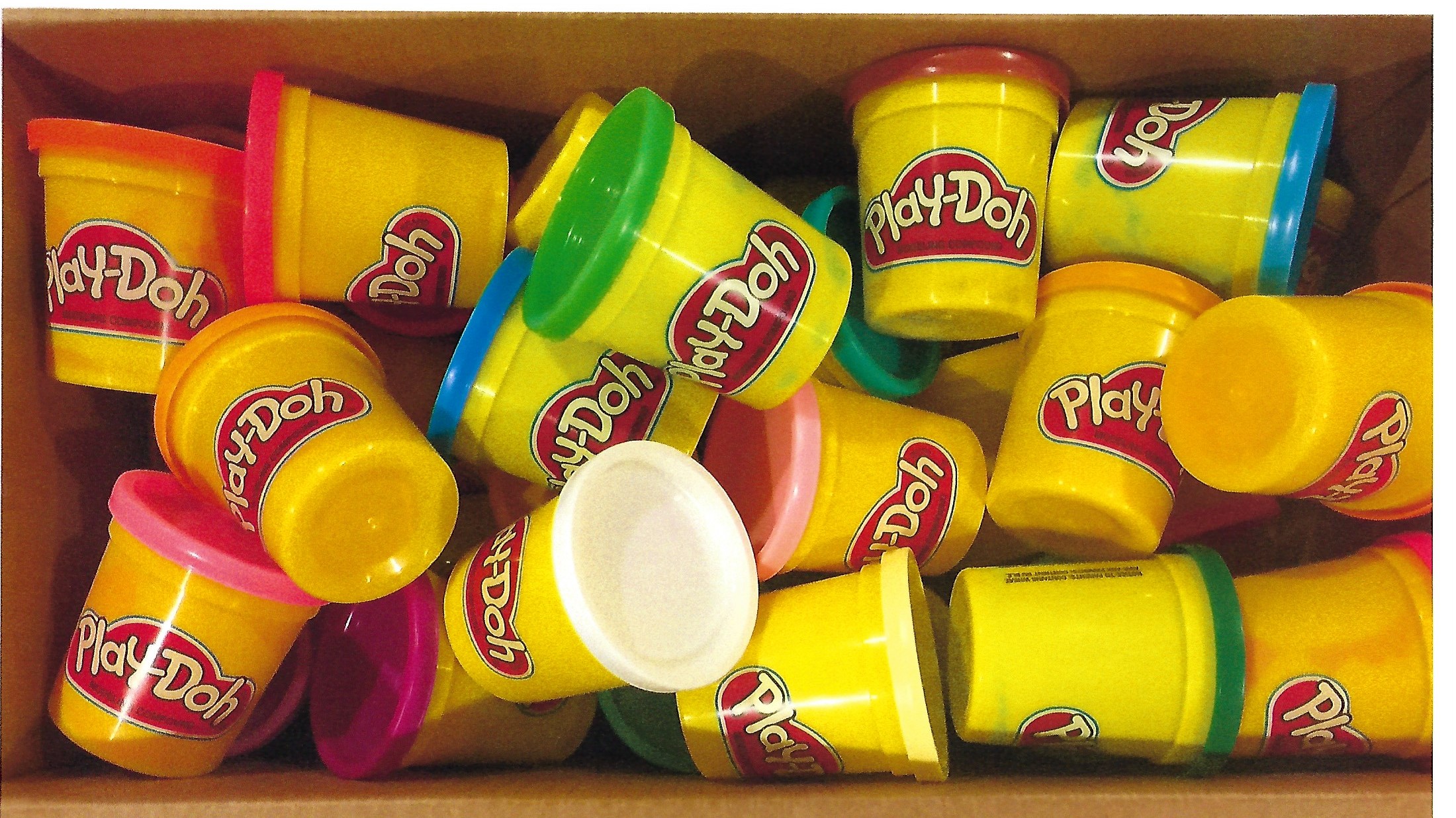
All of this came to mind a few weeks ago when a friend brought me a box of containers of play-doh. His sister had asked him to give them to me because she knew we had lots of children in our family. He didn’t say where she got the box of play-doh, only that she wanted to give them to me. He asked, “Do you think the little kids in your family would like play-doh?” All I could do was smile and say, “Yes, they love play-doh. Who doesn’t?”
— Jeremy Myers

 Sunday Brunch