My grandmother would switch from English to German when she was excited, disgusted, or didn’t want my six-year-old self to know what she was saying. When it happened, I knew something was up. Often, the switch would happen during a St. Louis Cardinals’ baseball game. The German phrase most often spoken by her–and which has been embedded in my brain for six decades–was Mein Gott in himmel!” It took years for me to learn just what it meant. When I did, it seemed a perfect response to her beloved Cardinals’ messing up. “Oh my God!” Other times, when it wasn’t the Cardinals who did something stupid but– more likely–the world as a whole, she would say, “Gott in himmel!” That means “God in heaven!” Again, it seemed a good response to the craziness of the 1960’s.
Things went up a notch when my grandmother’s close friends or one of her sisters visited. She had a friend that returned to the United States periodically–the woman had married a German-American (his fourth wife, I believe; she was the only one that outlasted him) and when he died she had returned to Germany–so her visits required the shift in languages. I’m not sure she spoke English. I never heard her do so. But I did hear my grandmother and her friend speak German at meteoric speed. I was fascinated as well as dumbfounded. I was speechless as their speech around the kitchen table filled the room.
There were a few other occasions when I remember my grandmother pulling out her German. These occasions–speculation on my part, since I didn’t speak German, but based on good deduction for a six-year-old boy–concerned adult matters that small ears didn’t need to hear. I deduced this was the motive because the conversation generally would be in English and suddenly would switch to German without explanation. This happened when my grandmother was speaking to her oldest daughter or to her oldest friend. I was left to assume it was related to family gossip in the former and community gossip in the latter. My grandmother never asked me to leave the room or to cover my ears for “adult-talk.” She simply switched languages, moving from English to German without a bat of the eye, or in this instance, without a slip of the tongue.
I still believe German is a hard language on the tongue and a hard language on the ears. It doesn’t have the smoothness of French or the flutter of Spanish or the sing-song of Chinese or the emotion of Italian. This is my opinion, of course. For me, German is guttural and sounds like the speaker has a stomach ache. I studied German for a semester. I picked up some of the language, but never quite could accept how one word might be added to on both ends and become something entirely different–like stacking wooden blocks together until they stretched a mile. Again, my personal impression. I’m sure my grandmother would be disappointed that I didn’t take to German any easier than I took to arithmetic. I remember my arithmetic homework provided many occasions, as she sat beside me, for her to utter, “Mein Gott in himmel!” I knew I was in trouble. But I didn’t like math then. I still don’t. It wasn’t part of my skill sets.
With my two great-grandfathers immigrating to the United States from Germany in the late 1800’s and with my two great-grandmothers being first generation German-Americans, you might think I was hardwired for German. I didn’t find it to be the case. I have held a life-long interest in the language and the people, but learning to speak German fluently never was achieved.
It is a historical fact that Germans held onto their language when they immigrated to the United States. While other nationalities either spoke English or wanted to learn English so they could fit in, Germans took pride in their language, as they did in most everything they did. They wanted their children to speak German, so they spoke German in the home, and they wanted schools that held classes in German. While the Mass on Sunday was spoken in Latin by the priest, the sermon always was spoken in German.
When Father Joseph Reisdorff founded the community of Rhineland for German immigrants in 1895, the language spoken in the community was German. A school was set up in 1898 in a room of the priest’s house. Classes obviously were held in German. The next year–1899–a one-room school was built and a man named John Keckeisen was hired as teacher. He primarily taught in German. My grandmother attended classes under him and spoke of him often. I think she found him demanding. In 1908, the pastor of the catholic community asked Benedictine sisters from a convent in Jonesboro, Arkansas if they would come to Texas to teach the children in the community. They agreed and they opened a school with twenty to thirty students. The first year only one nun was needed. A companion was sent with her to do the housekeeping chores.
The nuns taught grades one to eight. Cathechism and Bible history were taught in German. They also taught German reading and writing., which means almost everything was done in German. This explains why my oldest aunt, who was born in 1909, was able to speak to my Grandmother in German when the need for adult conversation arose and I was around. She had been schooled in it for the greater part of her education, if not all of it.
The move to English was slow and painful. The primary impetus for the move–at least as my grandmother told it and as I have found verified in other sources–was World War I, which began in 1914 and was ended in 1919. The loyalty of German-Americans was questioned since Germany was part of the Central Powers that was at war with the Allied Powers, to which the United States was adjoined. The simplest and the clearest way for the German community to prove its loyalty to its adopted country rather than its mother country was to stop speaking German and to stop teaching German in the school. My grandmother told a story of the time the local sheriff came to the little German school to see what the children were being taught and if it was anti-American. It seemed this move to English was finalized in 1920, shortly after the end of the war, when anti-German sentiment still was robust.
Other German Catholic communities in these parts underwent the same transition, some easier than others. I once heard a story about a German Catholic community some distance from here where the traditions stayed stronger and the personalities were more stubborn, so strong and so stubborn that the Sunday sermon was spoken in German until the next World War. When a new pastor was assigned to the parish at some point during that time period, he thought it was time to deliver the sermon in English. So, on that Sunday he went to the pulpit and began to speak in English. Just a few words out of his mouth later, an old-timer stood up in the church and yelled out in an angry voice, “We speak German here!” There were approving murmurs from the congregation. I’m told the priest switched to German and the congregation continued with their worship. I’m unsure when the last sermon was preached in German in that church, but I suspect it took a brave man to do it
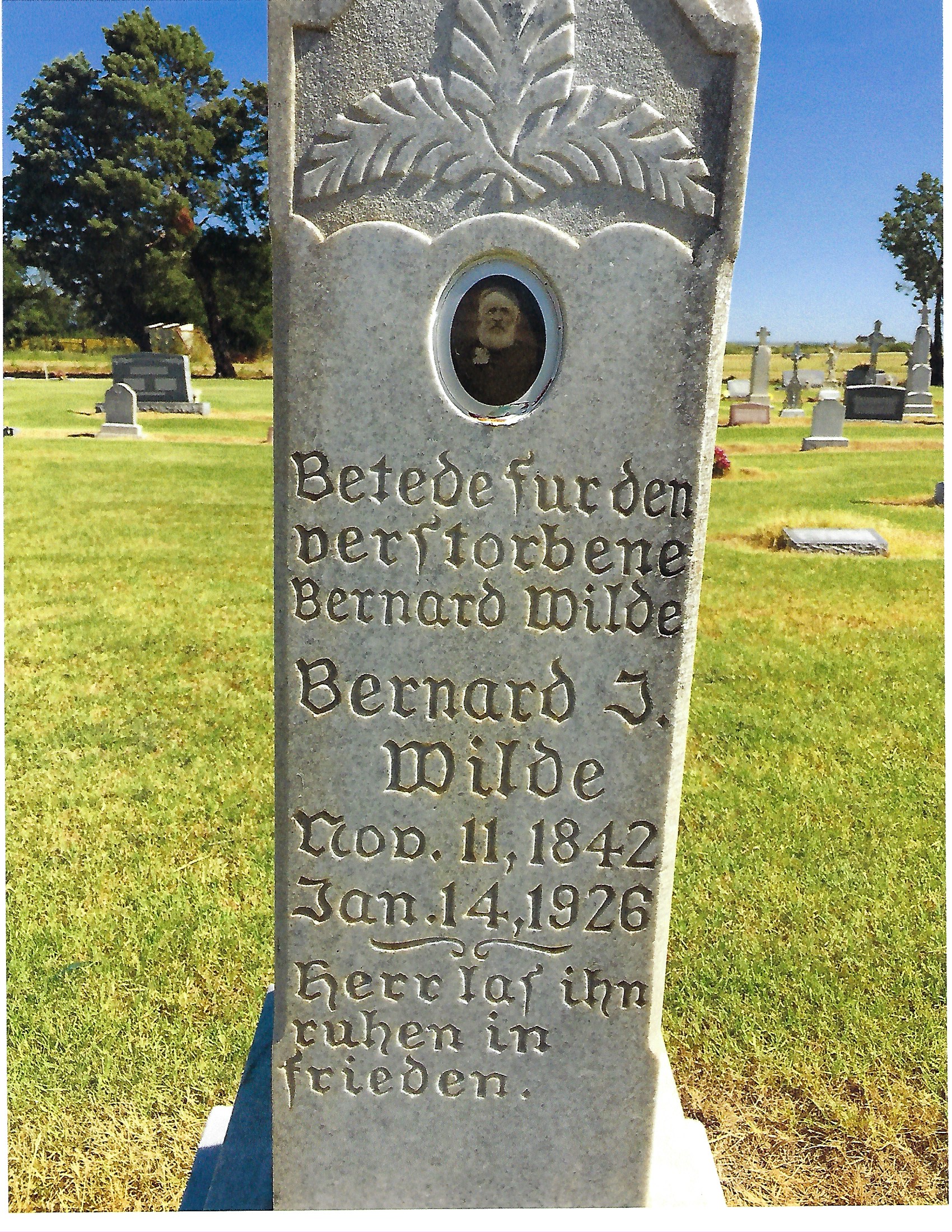
When my great-grandfather Wilde died in 1926, the inscription on his tombstone was done in German. Over the years, many have asked what the translation is from German to English. Translated it reads, “Pray for the deceased, Bernard Wilde. Lord, let him rest in peace.” When my great-grandmother Wilde died fourteen years later, in 1940, the inscription on her tombstone also was engraved in German. Translated, it reads the same as her husband’s: “Pray for the deceased, Petronella Wilde. Lord, let her rest in peace.” I found a copy of her obituary a few years ago packed away in an old envelope my grandmother had. The obituary was written in German. For these two, at least, they wanted German to be the last word spoken about them.
I’ve learned from sociologists who study inculturation that it takes three generations for the language of origin to disappear and to be replaced by the language of the adopted culture. I know this is true for my family. Whereas, my great-grandparents only spoke German, their children (my grandparents) spoke both German and English, and their children (my parents) spoke only English. Just as interesting, I think, is what linguists tell us. Originally, there was only one language in the world some 100,000 years ago when humans decided to babble. That language was spoken in Africa. As with other things in the world, the multiplicity of languages is the result of people moving from Africa into other parts of the world. That migration resulted in each group taking the home language and making changes to it along the way, until we now have six thousand languages in the world. The first attestation of English, scholars tell us, was around 450-480 A.D., which makes English one of the newest languages on the earth. We can say–with certainty–Adam and Eve did not speak English. Nor, for that matter, did Jesus. English-speakers were not around when he was around.
Another interesting idea proposed by these linguists is that 5,500 of the six thousand languages now spoken will be extinct by the year 2100. That seems difficult to imagine, but the explanation they offer is simple–globalization and urbanization. Once a language is no longer spoken, it is just a matter of time until it disappears entirely. As we have heard many times, Latin is a dead language–dead because nobody speaks it. It exists only on the page, studied primarily by students of the classics or of Scripture, something unfathomable to the ancient Romans. Cicero surely weeps.
As we know, the Judaeo-Christian tradition offers its own story on languages. It agrees that once upon a time everybody on the face of the earth spoke the same language. “The whole world had the same language and the same words” (Genesis 11.1). It also agrees that humans migrated from a singular place of origin. “When they had migrated from the east, they came to a valley in the land of Shinar and settled there” (Genesis 11.2). Then, the humans decided to build a tower to the high heavens–an image of humans seeking to be like God–and God in turn destroyed the tower as well as the singular language of the peoples. “The Lord said, If now, while they are one people and all have the same language, they have started to do this, nothing they presume to do will be out of their reach. Come, let us go down and there confuse their language, so that no one will understand the speech of another. So, the Lord scattered them from there over all the earth . . . That is why it was called Babel, because there the Lord confused the speech of all the world. From there the Lord scattered them over all the earth” (Genesis 11.6-9). Again, the tradition agrees with historians in that the people scattered all over the world. Here, though, the Lord is the source of the scattering, not the people who decided to take a long stroll on Sunday afternoon and never found their way back home. Furthermore, it is the Creator who brought forth the multiplicity of languages, not human beings.
I find it just as interesting that the Christian scriptures anticipates that time when there will be no distinctions among peoples such as languages or any such cultural identifiers. As we have heard many times at Sunday school or in a sermon, the Pentecost experience of the early followers of the Lord Jesus was a reversal of the Tower of Babel story. On that day, everyone in Jerusalem understood the one language spoken by the apostles. “They were astounded, and in amazement they asked, ‘Are not all these people who are speaking Galileans? Then how does each of us hear them in his own native language?'” (Acts 2.7). Later, St. Paul will make much the same prediction when he tells the people of Galatia, “There is neither Greek nor Jew, slave nor free person, there is not male and female, for you are all one in Christ Jesus” (Galatians 3.28).
Seemingly, the movement, natural history and Scripture say, is towards unity in language, among other things. Differences will disappear. Time will tell if they got it right. I daresay it is true in my own family history. No one speaks German anymore. One of my nieces studied German in college, but she teaches English in school. I don’t know what language will be spoken 100,000 years from now. Few of us will be around to hear it. Given that long view of history, I am left to wonder why all the disagreement and discord about the language one chooses to speak these days. After all, the last time we spoke the same language was 100,000 years ago in Africa and we likely will not speak the same language any earlier than another 100,000 years.
In the catalog of “Star Trek” episodes, there is one (Season 5, Episode 2) I still remember. In it, Captain Picard is stuck on a strange planet with an alien leader named Tamarian. Neither Picard nor Tamarian speaks the same language. And yet, their survival depends on their coming to some mutual understanding of language because there is a death-dealing force trying to kill both of them. Picard, like many of us, is slow in comprehending what the other leader is saying and the latter is the one with the greater knowledge of the deadly force. Eventually, Tamarian sacrifices his life so that Picard will live. Only then does Picard learn what Tamarian was trying to tell him. When he returns safely to the ship, Number One says to him, “New friends, Captain?” Picard answers, “Can’t say, but at least not new enemies.” Later, Picard says to Number One, “Tamarian was willing to sacrifice everything just for the hope of communication, connection. Now the door is open.”
There seems to be something almost Biblical in that story.
— Jeremy Myers

 Sunday Brunch