My mom never had a birthday cake when she was growing up. Not that her mother was uncaring or forgetful–she wasn’t–but it simply wasn’t a thing back in her day. At least not in her home. As a child, I found it difficult to understand because birthdays and birthday cakes always were synonymous in my mind. Apparently, they were not in my grandmother’s mind. I’m still left to ponder why the tradition wasn’t observed.
Historically, the Germans are credited with coming up with the birthday cake. Historians say that there is evidence of the custom in the 18th century in Germany. Parents would present a child with a cake with lighted candles on the morning of his or her birthday. The candles would represent the child’s age plus one additional candle. That extra candle was called “the light of life.” It stood on the cake as a wish for another full year ahead.
The candles on the cake would burn all day (replaced when necessary) until the cake was eaten at the evening meal. And as today’s children do, the child would blow out all the candles in one breath and make a wish. Apparently, the idea of a birthday cake didn’t become widespread until the cakes were able to be made with less cost. Now, a quick trip to Albertson’s or Walmart will give you a wide selection of ready-to-go-cakes or cake mixes for the energetic.
As a rule, my grandmother didn’t do cakes of any sort. She did make a chocolate cake with a special icing that is still a family favorite. The icing was a combination of butter and sugar and evaporated milk cooked on a stove. Probably a dash of vanilla, I suspect. A niece has the exact recipe. It’s the only cake and only icing I remember my grandmother ever making. She made pies. Also bread and cinnamon rolls, but not cakes. Again, not her thing.
I’ve pondered possible reasons why my grandmother didn’t do birthday cakes–or anything special for that matter, such as a gift–for her children’s birthdays. She had thirteen children, which is a partial explanation–and, in my mind–not a good one. I’m inclined towards the more logical explanation, such as having to bake in a wood-burning stove in her early years. That could not have been easy. Eventually, I’ve read, there was some effort to maintain a constant temperature even on these stoves, but baking still would have been hit or miss. My grandmother also tended to be no nonsense. Perhaps she thought a cake was frivolous. Or maybe she wasn’t aware of the tradition of a birthday cake, although she was from a strong German background.
I heard a professor of history–a pretty good one, at that–say in a lecture that women in the past (he used the Victorian Age as a good example) did not allow themselves to become overly attached to their small children because of the mortality rate of children in that bygone era. Doubtless there is some truth in that assessment. As a child, I would walk through our little cemetery in our community as I helped my grandmother put flowers on the graves of family members and I would ask her about the many small tombstones. She would explain that these were graves of babies and children who had died. Almost always, she would tell me the circumstances of their deaths. Maybe I asked. Either way, I walked away with stories of young lives lost. There were many in the old days.
Often, she would say they were “blue babies.” Later, I came to understand these were babies born with heart ailments. They would turn blue because of an inadequate amount of oxygen in the blood. Medicine had not advanced to the point where anything could be done for them. Mary Anne, my grandmother’s ninth child, was a “blue baby” and died a short while after birth. A great-uncle’s family plot has three small children buried in it. An aunt also had a small child die. So, there is no question that infant mortality was an all too common occurrence in the years before and during my grandmother’s time as a mom. It seemed each family in the community had suffered a death of a child. My niece celebrated her son’s 13th birthday a few weeks ago. Had he been born a century ago, he would have been one of those “blue babies.” Instead, he is a tall, athletic boy with a continuous smile on his face. His only problem is English class in school. When he was small and I asked him what his favorite subject in school was he answered–in all seriousness–“recess.”
Again, I don’t know the reasons my grandmother didn’t bake birthday cakes for her children. I trust she had her reasons, whatever they were. My mom, on the other hand, believed in birthday cakes. Her’s was a different generation. She made sure each of us had a birthday cake, usually chocolate (at least when we were young). Later, whatever cake we preferred. One interesting aspect of our birthdays was the fact that several of us were born close to the same date in the same month. Different years, of course. So we were bundled together for birthdays. I was one of those multiple birthday celebrations. I had two sisters born the day after my birthday, so the three of us shared a birthday cake. We still do. I also had three brothers in August who shared a birthday cake. Same with two sisters with birthdays in late February.
I sense that sharing a birthday cake with a sibling would not make a child happy today. Everybody wants to feel special. Whereas my grandmother did nothing special for her children’s birthday, today’s moms–as a rule–make the day very special for their children. Again, sociologists say modern parents have fewer children and so there is more of everything to give to each one. When my fifth sister was soon to be born, my first sister (whose birthday was the day after mine) and I both wanted her to be born on our birthdays. My sister won. Now, she and my fifth sister share a birthday. So, the three of us grew up sharing a birthday cake. We have many pictures of the three of us holding one cake. Last week, my sister and I had the customary picture taken of us with the one birthday cake. Our other sister lives out of town and wasn’t home for the celebration. If she had been, she would have joined us on the picture, just as we did in past years .
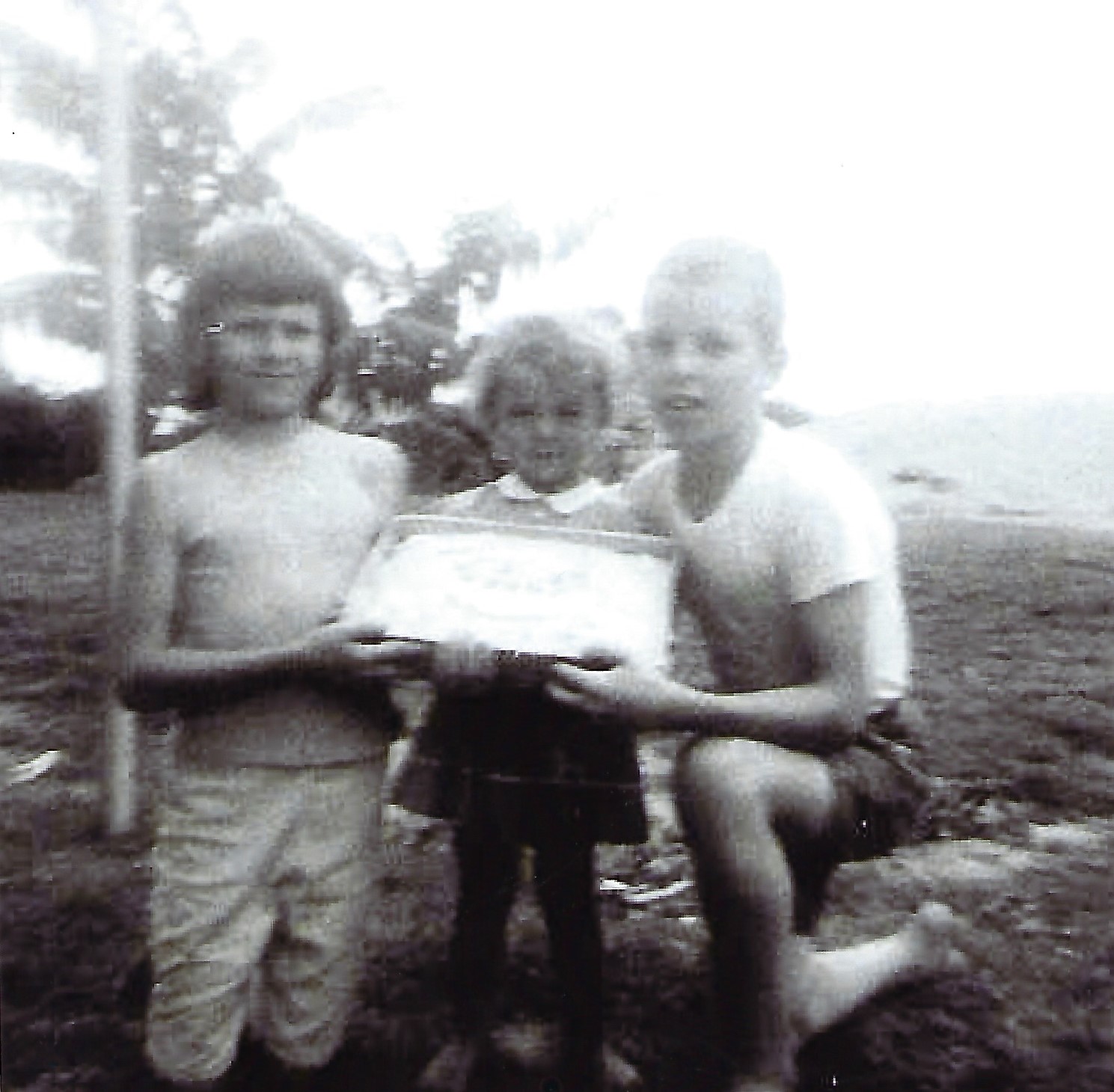
That same sister, by the way, was a sociable person from the moment she was born. As a young girl, she always was visiting the neighbors’ houses where there were other children her age. I always have argued that she stayed away from home so much because she was trapped among five brothers. It was an oddity of birth order, but she didn’t get a sister until she had five brothers. Eventually, she would have many more sisters. As things go, sixth boy was trapped among those seven sisters. I use the word “trapped” as my way of looking at it. You’d have to ask them if they felt trapped.
One summer, as we were sitting down to lunch–and it was my sociable sister’s birthday–we could see some neighborhood kids outside the kitchen windows. We asked what they were doing at our house at that time of day. My sociable sister–probably nine or ten at that point–said she had invited them to her birthday party. My mom scrambled to get together some semblance of a party she had no idea she was going to have that day. I don’t remember what she pulled together in the kitchen, but my sister and her friends had some kind of “a party.” It’s become a family story–the day my sister invited her friends to her birthday party that nobody knew about.
Another thing that my mom did to make our day special was to cook each of our favorite dishes. So, I had fried chicken on my birthday each year as I was growing up. After I was grown and out of the house, I still got fried chicken for my birthday if I happened to be home at the time. Last weekend, as we celebrated my sisters’ and my birthday at a family get-together, my brother-in-law grilled wonderful burgers. We had a wide assortment of other dishes, all delicious. But I could not help but think of my mom’s fried chicken. It was one more way I missed her.
I hear people–usually older people–talk about “difficult” birthdays. We’ve tried to lighten the truth of getting older by humorous celebrations of our fortieth birthdays. One woman told me that turning sixty was difficult for her. Another woman who had celebrated her sixtieth birthday kept saying to me, “It’s just a number. It’s just a number.” Obviously, she was trying to convince herself. I already knew sixty was a number. For my part, turning forty was much ado about nothing. Fifty had a different feel to it. Sixty was fine. I had had a decade to prepare for it.
These days, birthday celebrations often have morphed into big-time and big dollar events. A simple cake and maybe your favorite meal just aren’t enough anymore. We see bounce houses rented, thirty or forty kids invited to a party, maybe a meal at Chucky-Cheese for everybody, lots of cards, gift cards, toys, trips. Birthdays are a very big deal. My grandmother wouldn’t recognize them. She’d think the person was being canonized, not just having a birthday celebration.
That brings to mind another interesting point. In the early Christian church, a martyr for the faith was remembered, not on his or her birthday, but on the day they died. More interesting, the date of death then was called the martyr’s “birthday.” The reason was simple enough. Believers held that on the day of death the person was born to new life in heaven. Hence, their birthday. That tradition still carries to the present day, after almost two thousand years. A saint’s life is celebrated, not on his or her date of birth, but on the date of his or her death. It is that “birthday” that counts.
For the same reason, the greatest celebration on the Christian calendar is Easter, the day when our Lord rose from the dead. It was only centuries later that Christians began to celebrate the day of our Lord’s birth, known to us as “Christmas.” Of course, no one actually knew the day he was born, so it seems the Christians took a pagan feast associated with the winter solstice, baptized it, and called it Jesus’ birthday. And, as we know, it has become a huge celebration. Still, it is second to Easter–at least on the books– though not so much in popular culture.
We’re left to answer the question of just what does a birthday mean to us. We hear many answers. Most children eagerly look forward to their birthdays–and with good cause–because the day is all about them. Older people tend to celebrate less the day, as if birthdays are for kids. One of my sisters always made a point of taking a free day from work on her birthday. Perhaps it was an effort to return to the freedom of childhood. Or it may have been a simple acknowledgement that there is more to life than work. I’ve noticed that as the years add up, some people try to ignore the day, as if ignoring it will mean there isn’t another year added to the total and–more sobering–a year taken away from our time left on earth.
I think birthdays are a good thing. I think they should not pass without notice. Supposedly, it was the Egyptians who came up with the concept of celebrating birthdays. They believed that when the Pharaoh was crowned, he became a god. This was the day of his birth as a god. It was celebrated with grand festivities. We can see it’s a small step to early Christians celebrating the day when a believer became a saint. And, as history moved on, we celebrated birthdays for everyone, saints and sinners alike. (By the way, candles atop the cake seem to have come from the Greeks, who wanted their moon-shaped cakes to look more like the moon, and so put candles atop it.)
I know this much. A birthday is important because each life is important. It is the beginning of a person’s days on earth. All beginnings are important. Moreover, just as there is a beginning, so there will be an end. The days between are the stuff of our lives. It is the time we have to become the person we want to be and, on occasion, to become the person our Creator wants us to be. An annual recognition of that movement through time towards our goal or “destination” is a reminder that time is a limited commodity. When it is done, it is done. So, making a wish on that birthday cake may not be as silly a gesture as it seems on the surface. I suspect most all of us would wish for more time. And isn’t that what a birthday is really about? We have been given more time, at least for now.
Grandma Kuehler’s Icing for her Chocolate Cake
Warm together 1 can evaporated milk and 1 stick of butter, then gradually blend in sugar until it melts and is consistency desired. This varies between one and two cups of sugar. Should be cooked slowly on low heat until thick. Add tsp vanilla.
— Jeremy Myers

 Sunday Brunch