Adam and Eve is the first recorded story of boy meets girl, at least in the Bible. As far as I know, Adam didn’t use a dating app. The story I got says his Maker started out with a parade of animals, hoping the boy would take one of them as a pet, each one passing in front of the boy, but Adam was not impressed with any of them. Mind you, not even the dog, which is supposed to be man’s best friend. The Divine Maker went through the animal kingdom and, as Scripture says, “none was found suitable as a helper for the man.” So, never one for lack of creativity or for not going back to the drawing board, the Maker stole one of the boy’s ribs while he took a nap later that afternoon and the Maker used the rib to form a girl. This one Adam liked. The Maker was relieved. He was able to rest on the seventh day.
Of course, there is another version of the story not told in the Good Book, but told by later Jewish scribes who had a tendency to fill in any and all blanks they found in said book. Here’s the problem they tried to fix. There are two very different versions of the boy-meets-girl story within just a few paragraphs. Most of us are familiar with the second version, the stolen rib one, which doesn’t–on the surface–seem a promising way to meet your future wife. However, the other version–an earlier one, at least in appearance in the book– simply says “In the image of God he created them, male and female he created them.” The conflicting stories bothered the learned scribes enough that they wanted to fix the problem because, as I said, they liked things neat and clean.
Here’s the fix they came up with. The scribes decided these were two separate events, not one and the same. It seemed obvious that the girl was created differently in version one than in version two, so they decided the logical answer was that Adam had two wives. The first wife they called Lilith. Then the second wife was Eve, as named in the Scriptures. For some reason, wife number one was a hellcat (Remember, these scribes are making it up as they go along). According to stories told and retold and circulated and recirculated, Adam and Lilith immediately began fighting worse than the cats and dogs in Paradise. The reason was that neither would submit to the other. Seeing soon enough that Adam would not listen to her, Lilith flew the coop, literally flying away into the air. Apparently, she had wings. Some stories say she later caused big problems for Adam’s second marriage. I don’t think any of us have reason to doubt that possibility.
If the story of Adam and Lilith should hold up–and I’m not saying it should or does or will–then it makes clear almost all boy-meets-girl stories have their difficult moments. In fairness, we should not overlook that the second wife also brought some problems into the marriage when she befriended a snake in the grass. That bad boy was a real charmer and poor Eve was a country girl who never had been to the big city, so what did she know? I still think she got a bad rap from the whole affair.
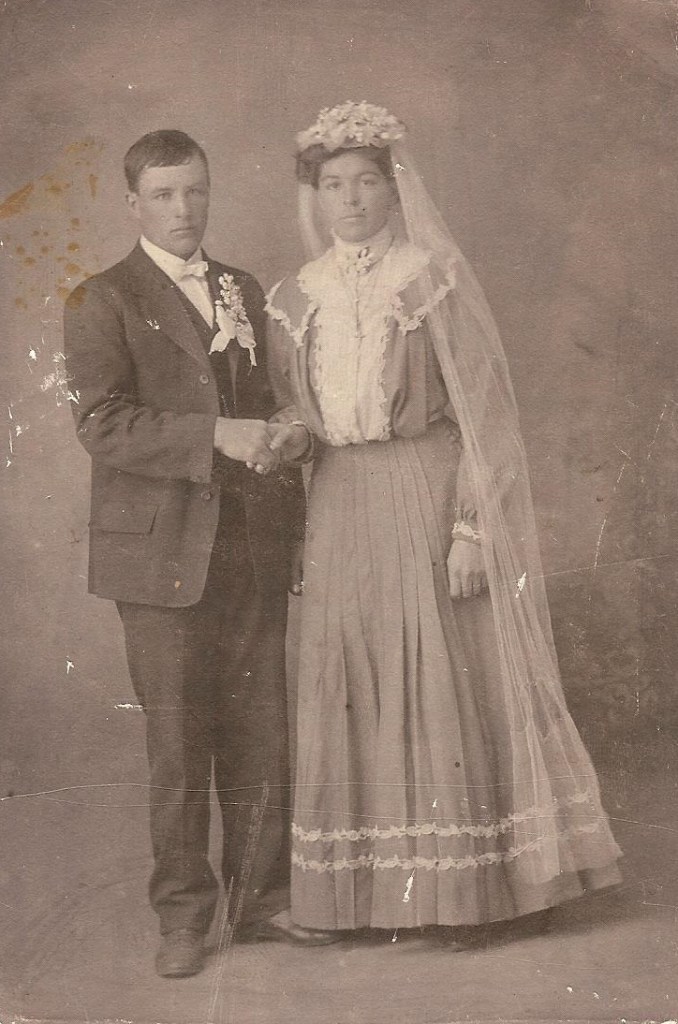
As a small boy, my grandmother liked to share her stories of boy-meets-girl (not the above, of course), especially if the girl was her and the boy was my grandfather. My grandmother liked to say she got the best of the Kuehler boys when she married Tony in 1908. Logically, she would have said it, but I also have no reason really to doubt it. My grandfather was one of eleven boys and–by all accounts–he was quiet, kind, and not a fighter. Not the same could be said of each of his brothers–although I have no first-hand knowledge, only stories told to me by my grandmother, who had her bias in this matter. Not that she thought the other Kuehler boys were hellions, just that the one she got had a gentler spirit.
I don’t know how long their courtship lasted, only that it brought them to the altar on January 28, 1908. They were married in the little wooden church in the center of the little German community in which they had lived since 1898 by a priest named Father Luke Hess, who was a musician as well as a minister. It is said he had a nervous disposition, although my grandmother said nothing of it. Again, I have no first-hand knowledge, just stories passed down. Obviously, he did a fine job with the wedding of my grandparents. I never heard my grandmother complain about him. Their marriage lasted until 1958, when my grandfather died of cancer. My grandmother grieved for Tony for many years. Some would say–including me–that she never adjusted to life without her husband. That, I know, from first-hand knowledge. The picture taken of her with her children after her husband’s funeral shows a forlorn and a fragile woman.
My grandmother shared one thing about her wedding that has stayed with me. She wore a blue dress. Already as a small boy, I knew girls wore white dresses on their wedding day, but my grandmother explained that blue dresses for a wedding were the style when she married. Somewhere, there is a picture of her in her blue wedding dress. When I asked her if I could see it, she said she had cut it up at some point to sew clothes for some of their children. Those pioneer women, I have to say, were practical to a fault. No room for sentimentality for sure.
She wore her wedding ring until the day she died. At some point, the ring did not pass over her knuckle anymore. Towards the end of her life when she had lost weight, the ring could slip off her finger, but she never removed it. The only time I saw her remove the ring was when I would ask her to show it to me. Their initials were engraved inside the band, although the initials were worn after so many years. When my grandmother died, her ring was passed on to my mother. When my mother died, the ring was passed on to my sister, who was named after my grandmother. It is a ring with a story.
I once was told of a wedding ring with a diamond setting placed in a church poor box with a note that read, “Sell for church.” When the priest took the ring to a jeweler, he learned–to his surprise–the ring was valued at $5000.00. I wonder what the story behind that ring was. I don’t think it ended well.
I remember another story my grandmother liked to tell me about the time she was dating my grandfather. It seemed one of the ways that the church made money was for girls to make a meal, place it in a lunchbox hand-decorated, and the meal would be auctioned off to the highest bidder at the church picnic. The important part of the story is that the girl went with the meal. So, whichever boy bid highest for the lunch got to eat it with the girl who prepared it. I could see–even then–potential problems with that method of boy meets girl.
My grandmother confirmed a few of my misgivings. She still resented that the boy in whom she was interested–Tony–didn’t get to eat the meal she had prepared for them, but instead she had to eat it with another young man who outbid Tony. Once upon a time, I knew who that other guy was, but no more. I have every reason to think he was a fine person. The problem, in my grandmother’s mind, was that he wasn’t my grandfather. Another problem, confirmed by my grandmother in the telling of the story, was that some meals went for next to nothing. Not that the food wasn’t any good–just the boys weren’t interested in eating with the girl who prepared it. As you might come to expect, these girls were embarrassed in front of the entire community. Such happened to her best friend, who came from a poor family and so couldn’t dress up the lunch box or herself in such a way so as to catch a boy’s eye.
Back then, I wondered who thought up this money-making method that could be just as heartbreaking as it could be heartwarming. As I reflect on it, It seemed as full of disappointments as our modern day dating apps. Not knowing better, I thought this quaint means of bringing a boy and a girl together was a local peculiarity. I should have known better. Not that long ago, I was reading a book by Rick Bragg, one of the South’s best writers, and he was talking about his grandmother and how she met her husband in Georgia. Here’s the thing that Rick said that got my attention, “At the socials, girls of courting age would fix a box lunch and boys of courting age, and sometimes old men who had been widowed, would bid on the food–but of course what they were really buying there was the pleasure of the young woman’s company for the time it took to eat.” So, I learned from Rick that it wasn’t just a custom at church picnics in these parts of Texas. Those lunch box auctions were a thing in other places in the South.
Mr. Bragg points out that his grandmother lied a bit because she didn’t cook the meal. Her sisters did. He says they figured his grandmother would never get to the altar if she poisoned a man to death. So they fried the chicken and boiled the eggs and put in a piece of pound cake and dressed Ava (his future grandma) in a pretty cotton dress with red flowers on it and tucked the box under Ava’s arm and pushed her onto the stage, where, as Bragg says, “fate and Charlie found her.” It didn’t go so well for my own grandmother, at least at the auction.
Bragg also points out that a dance usually followed the event. Again, I remember my own Grandma talked about the dances that she went to when she was a young girl. However, there were strict rules back then about dances and dancing and damn near anything and everything that might bring a boy and a girl close enough to cause trouble. In my grandma’s courting days (a hand-me-down word, I assume, from courtier), the Pastor was in charge of near everything in the community. The original pastor who founded the community in 1895 didn’t like dances. Period. He said he would not give absolution to anybody who confessed to dancing. Not that the threat stopped the dancing, just the confessing of having done the dancing.
My grandma loved to tell the story of the young woman at one of those dances who was having such a good time that she took off her corset and went on the dance floor without that confining piece of clothing. According to Grandma, that young girl was on the train to a convent in Galveston the next morning. I am not so sure it happened that quickly. But I do know the same girl–who made a good nun in time–did contribute a paragraph to an early history book of the community in which she said the same thing–the Pastor did not like dances. The good nun did not expound on the corset incident, but I have confidence it is true. Those are the details that seem to make a story worth retelling, and also the details worth forgetting, at least by some.
A cousin, thirteen years younger than my grandmother, told me similar stories of the dances where boys would meet girls. In her stories, told to me when she was 102 years old, the Pastor again made the rules. One of the cardinal rules that no one broke was that a boy could not attend a dance until he was sixteen years of age and until he had passed an exam of his catechism as provided by the priest. She liked to tell the story of a young man–about five years older than her–who had a fun-loving, sociable, partying attitude and went to a dance when he was some weeks short of his 16th birthday. The Pastor pulled him off the dance floor, took him to the church, and demanded he answer every question from the catechism that he posed to the boy. Much to the surprise of the priest, the young boy answered each question correctly and so he was allowed to return to the dance. I think of that boy often because he died when he was twenty-two years old. I hope he got to dance a lot before he was laid to rest.
I know we find some of these old ways hard to believe and harder to accept. But every age has its ways and means for a boy to meet a girl. We want to believe ours make more sense, because it does to us, but time will tell how sensible they are. I suspect future generations will get a good laugh out of our dating rituals. “What in the hell,” they’ll say, “was an app?”
Anyway, even though my grandfather didn’t bid high enough to get my grandmother’s box lunch, he did get the girl. And, in the end, that’s how these stories are supposed to end. Boy meets girl. Boy gets girl. They live happily ever after. Who, I ask, doesn’t smile when a story ends that way?
— Jeremy Myers

 Sunday Brunch